
JULY 6, 2023 GRACE EBERT
 “No. 382 of the Poly S. Tyrene Memorial Maritime Museum” (2023), painted, salvaged plastic, ink, wax, 12.5 x 8 x 3.5 inches
In the 1860s, the U.S. government introduced kerosene as an alternative for lighting lamps. Whale oil had previously dominated the market but was unsustainable given the appalling number of animals killed in order to provide power. The country quickly transitioned to fossil fuels, swapping one harmful and extractive practice for another. While whaling had its economic implications, it also birthed a largely nautical art form known as scrimshaw, or engravings in bone or ivory.
Artist Duke Riley is attuned to this history and its modern-day implications. He gathers laundry detergent jugs, flip-flops, and bottles that once held household products once they wash up near beaches and carves incisive allegories and ornamentation into their surfaces. Painted in a warm, grainy beige, the scavenged waste mimics the whale bones traditional to scrimshaw while the artist’s signature wit emerges through the contemporary narratives of oil barons or marine creatures carrying human trash.
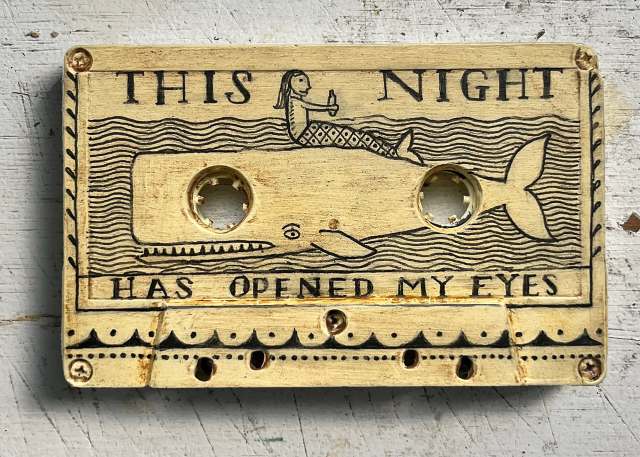 “No. 363 of the Poly S. Tyrene Memorial Maritime Museum” (2023), painted, salvaged plastic, ink, wax, 2.5 x 4 x .25 inches
Having grown up in New England, Riley frequented maritime museums with his family as a child. These experiences formed his “early ideas of what art was,” and the marine, folk art aesthetic emerged early in his practice—it’s also unsurprising that today, Riley frequently works from a boat docked near Rhode Island. As problems with waste and plastic pollution became more obvious during his visits to the ocean, he saw an opportunity to expand his scrimshaw works. “I was walking down the beach one day, and I found a piece of plastic that I thought was a bone and picked it up. It turned out to be a deck brush handle for scrubbing a boat deck,” he tells Colossal.
This encounter prompted what’s now a growing series of engraved sculptures, many of which comprise the Poly S. Tyrene Memorial Maritime Museum. Diverging from the cheerful, bright colors of packaging, Riley distorts the containers designed to promote unchecked consumption at the expense of the environment. “I have always used a lot of found materials,” he shares. “For me, it’s about taking a found material or something that’s discarded or trash and trying to transform it in a way that it’s almost no longer recognizable.”[…]
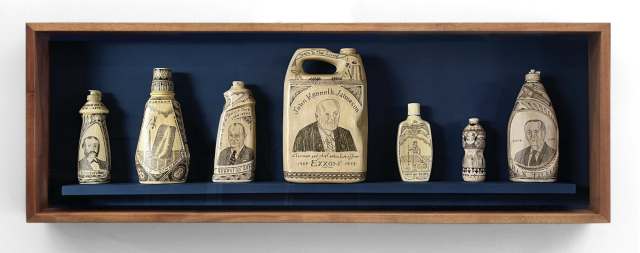 “Echelon of Uncertainty (Bad Guys)” (2022), salvaged painted plastic in wood and glass case, 18 x 51 x 6 inches
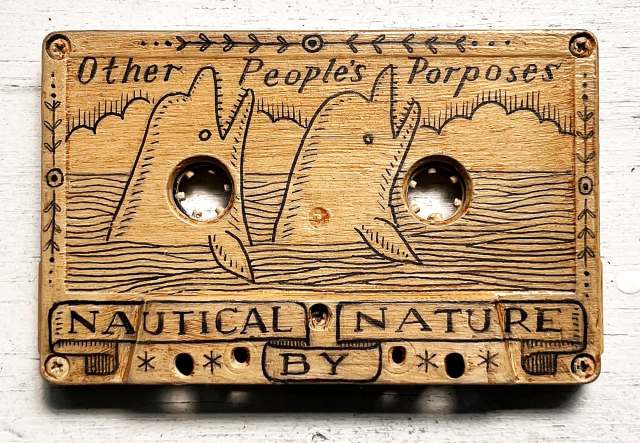 “No. 367 of the Poly S. Tyrene Memorial Maritime Museum” (2023), painted, salvaged plastic, ink, wax, 2.5 x 4 x .25”.

 msamba