
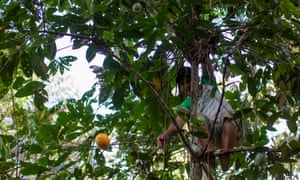
In Brazil’s largest indigenous reserve thousands of saplings have been planted as an alternative to profits from illegal gold mining
The villagers walk down the grassy landing strip, past the wooden hut housing the health post and into the thick forest, pointing out the seedlings they planted along the way. For these Ye’kwana indigenous men, the skinny saplings, less than a metre high, aren’t just baby cacao trees but green shoots of hope in a land scarred by the violence, pollution and destruction wrought by illegal gold prospecting. That hope is chocolate.
“We want to plant and develop income for the community,” says Júlio Ye’kwana, 39, president of the Ye’kwana people’s Wanasseduume association, which came up with the idea. “And it is not destructive for the forest.”
In the last two years, thousands of Theobroma cacaotrees have been planted near Waikás and other villages in the remote Yanomami indigenous reserve. The saplings were planted within the forest because cacao likes shade, an idea borrowed from agroforestry techniques successfully used for cacao elsewhere in the Amazon.
Villagers hope that within a few years rich, organic chocolate will be produced from the golden cacao fruit these trees bear. The project – run by the reserve’s indigenous associations Wanasseduume and Hutukara with Brazilian non-profit group Instituto Socioambiental (ISA) – is ambitious, but experts say it is based on a potential commercial reality.[…]
Read More: Cacao not gold: ‘chocolate trees’ offer future to Amazon tribes

 msamba