
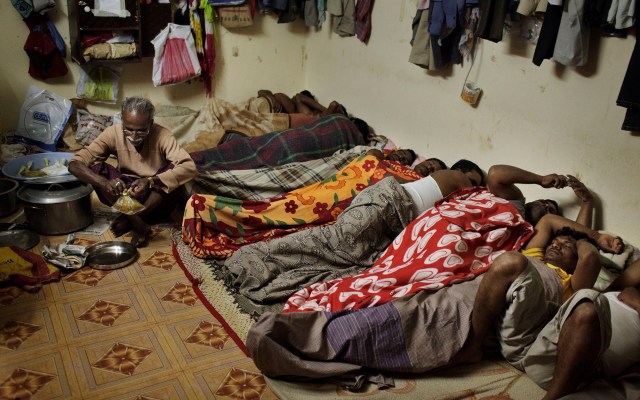
 Migrant construction workers sleep on the floor in Dubai in 2012. Photo by Jonas Bendickson/Magnum
is adjunct professor at New York University School of Law and emeritus professor at Seton Hall University School of Law. He is the organiser of a website on the Islamic law on slavery, ijma-on-slavery.org. His most recent book is Possessed by the Right Hand: The Problem of Slavery in Islamic Law and Muslim Cultures (2019). He lives in New York City.
The glittering city-states of the Persian Gulf fit the classicist Moses Finley’s criteria of genuine slave societies
The six city-states on the Arab side of the Persian Gulf, each formerly a sleepy, pristine fishing village, are now all glitzy and futuristic wonderlands. In each of these city-states one finds large tracts of ultramodern architecture, gleaming skyscrapers, world-class air-conditioned retail markets and malls, buzzing highways, giant, busy and efficient airports and seaports, luxury tourist attractions, game parks, children’s playgrounds, museums, gorgeous beachfront hotels and vast, opulent villas housing fabulously affluent denizens. The six city-states – Dubai and Abu Dhabi in the United Arab Emirates (UAE), Manama in Bahrain, Dammam in Saudi Arabia, Doha in Qatar, and Kuwait City in Kuwait – grew into these luminous metropolises beginning in the 1970s, fuelled by the discovery of oil and gas, an oligarchic accumulation of wealth, and unconditional grants of political independence from the United Kingdom, the former colonial master of the region. Thereafter, the family-run polities that took control of these city-states began to attract huge amounts of financial capital from all over the world. Abu Dhabi, the capital of the UAE, has been described as ‘the richest city in the world’, with wealth rivalling that seen in Singapore, Hong Kong or Shanghai. Like those cities, Abu Dhabi is swimming in over-the-top affluence. According to a 2007 report in Fortune magazine, Abu Dhabi’s 420,000 citizens, who ‘sit on one-tenth of the planet’s oil and have almost $1 trillion invested abroad, are worth about $17 million apiece’.
The Persian Gulf has a venerable history, stretching back to ancient times. It has always been a cosmopolitan and diverse centre of wealth and commerce. For nearly 1,000 years, Dilmun, a Bronze Age Arabian polity based in what is today Bahrain, controlled the trading routes between ancient Mesopotamia and the Indus river valley. During the Abbasid caliphate, a 500-year-long Islamic empire based in Baghdad, mercantile entities in Basra and al-Ubulla,at the head of the Gulf, dominated trade and commercial links with East Africa, Egypt, India, Southeast Asia and China. One could buy anything in this trade, including giraffes, elephants, precious pearls, silk, spices, gemstones and very expensive Chinese porcelain. Omani Arabs, who periodically controlled the maritime entrance to the Gulf at the Strait of Hormuz, were known as the ‘Bedouins of the Sea’. They came to control the trading routes with East Africa, transporting spices, precious stones and many other luxury commodities.
Slavery and slave trading formed a major part of this commercial history, particularly after the advent of Islam. Africans, Baluchis, Iranians, Indians, Bangladeshis, Southeast Asians and others from the Indian Ocean littoral were steadily and involuntarily transported into the Gulf in increasingly large numbers, for work as domestic servants, date harvesters, seamen, stone masons, pearl divers, concubines, guards, agricultural workers, labourers, and caretakers of livestock. Historians have noted that there was a great upsurge of slave trading into the region in the 18th and 19th centuries, during the heyday of the Indian Ocean slave trade. Many Persian Gulf families became very wealthy as a result of this upsurge. This is the backdrop for what turns out to be a very ugly and sad aspect of the spectacular rise of contemporary social orders in the six Gulf city-states. Each is an example, and perhaps the only examples existing in the world today, of what the sociologist Moses Finley (1912-86) called a ‘genuine slave society’.
Finley is one of the most important scholars of slavery. His book Ancient Slavery and Modern Ideology (1980) has had a profound effect on how scholars across the social sciences understand and study slavery. He argued that the slave, in contrast with the ordinary labourer, is an income-producing commodity – a species of property to be bought, sold, traded, leased, mortgaged, gifted and even destroyed, like other commodities – and this special status permitted exploitation of the slave in ways that were unique and central features of many societies. He divided these societies into two categories: those societies that could be described as ‘societies with slaves’ and those that he described as ‘genuine slave societies’, that is, those where slavery was an essential aspect of the society’s self-definition. The genuine slave society can’t function without the presence and work of its slaves. Some argue that the core definition of slavery has changed in contemporary sociological theory and practice since Finley’s time. This change recognises a phenomenon commonly described as ‘modern slavery’. I disagree. Applying Finley’s model to contemporary Persian Gulf societies, I argue that this change, indeed expansion, in the definition of slavery makes no difference in the analysis, and might make it even easier to apply the model to the Persian Gulf city-states. They are just as much genuine slave societies, using Finley’s analysis, as were the ancient societies he described.
In reporting on slavery today in the Gulf city-states, I rely on statistics from a number of sources. Inevitably, some of these statistical sources are more reliable than others, but I have made an effort to use sources that have been vetted or are generally accepted as the product of sound and reliable methodologies. I think that the statistics employed in this essay are as accurate as can be obtained under the circumstances. As every reader knows, however, no set of statistics is completely foolproof, and the Persian Gulf governments obviously have an interest in promulgating statistics that are favourable to them.
In the region, migrant workers make up a large percentage of the population – for example, in the UAE and Qatar, they constitute around 90 per cent, in Kuwait, this is around 66 per cent, and in Saudi Arabia, around 33 per cent. These labourers have few rights in the legal systems of the city-states, and a great majority work in very dangerous circumstances on huge construction sites, frequently risking death or serious physical injury from hazardous worksite conditions, including long hours without breaks, debilitating heat approaching 50 degrees Celsius or 122 degreesFahrenheit, a lack of elementary safety precautions and the absence of competent supervision. Reputable labour organisations have reported that one or two workers die on these construction sites every day and, in Qatar, which is preparing to host the 2022 FIFA World Cup, more than 4,000 migrant workers will die in workplace accidents on FIFA projects before the event takes place. No other construction project in the world even comes close to such rates of death.
A construction worker in Dubai earns about AED106,000 (US$28,000) a year compared with the AED258,000 (US$70,251) per capita yearly prevailing wage in the city. The same is generally true in each of the other city-states. Construction workers are housed in squalid dormitories. In these work camps, 20 to 30 men can end up sharing one bathroom, with eight or more sleeping in the same room. Passports and other travel documents are confiscated upon arrival and workers essentially spend all of their waking hours on the construction site; they are transported to and from the sites each day with little or no chance to see or enjoy the city they are helping to build. Those who don’t work on the construction sites can be found working as domestic servants throughout the region, often completely hidden from view, and others are employed in commercial and industrial enterprises, working as drivers, cleaners, caretakers, security guards, carpenters, plumbers, pipefitters, stone masons, and in a variety of other workplace occupations.
All of these migrant workers are from locales outside the Persian Gulf. None are citizens of any of the Persian Gulf nations, and there is no path to citizenship or even to permanent residency for any of them. Social and legal discrimination against them is openly tolerated and widespread. They often end up in the Persian Gulf after responding to deceptive and misleading advertising in their home countries, causing them to either pay large sums or to borrow such sums from employment agents to secure employment in the Gulf and to pay for their transportation, housing and food. When they arrive, they learn that, based on the value of their wage in real terms, it will be nearly impossible to pay off any debt they have incurred or replenish the sums they have expended. This encourages their employers to withhold, delay or simply not pay wages, coercing the workers to remain on the job, sometimes for a lifetime. In the meantime, migrant workers don’t have the same rights to educate their children, change their employers, pursue education or training, enjoy leisure time, or partake in any of the other pleasant amenities of life that Persian Gulf citizens take for granted. It’s also clearly a race-based system. Almost all of the migrant workers I have described are brown-skinned or even darker. Skin colour is therefore a marker for their low social status and an invitation by local citizens and officials to discriminate against them.
The kafala regulations bind the worker to the employer in the same way that slaves are bound to their owners
Domestic workers, also usually darker-skinned women from Bangladesh, the Philippines, East Africa and other locales, come to the Gulf under similar circumstances. They’re frequently not paid, subjected to delayed wages or underpaid for their work. They’re required to work long hours with no time off, and can’t get medical or dental care. They’re subject to sexual abuse by employers and other forms of violent exploitation and, like construction workers, they aren’t allowed to venture away from the worksite without permission of the employer. Punishment for misdeeds can be extreme because there is little or no regulation of domestic employment by the authorities. Many women migrants are deceived or coerced into working in brothels and other sexually exploitative circumstances. Dubai has thus become famous worldwide for the availability of young women for sex.
The kafala (sponsorship) system binds all low-status migrant workers in the Gulf to their employers. Generally, the kafala system requires the worker to obtain the employer’s permission to travel or leave the worksite to look for other employment. Regulations require a minimum of two years of work for the sponsor (kafeel) before such permission will even be considered. This encourages widespread wage suppression and conspiracies to deny such permission. Such ‘labour bans’ effectively bind the worker to the employer for a long period of time. More significantly, a worker can’t get an exit visa from the government without permission of the kafeel. According to recent reports from Al Jazeera and the Middle East Eye online news portal, employers frequently use the kafala system to force workers to endure abuse. If workers reject employers’ demands, the employer can accuse them of vague crimes or breach of contract. Being out of compliance can result in deportation without pay, a significant fine or a prison sentence. The kafalasystem effectively doesn’t allow workers to dispute non-performance of the employment contract or lodge any serious complaint against their employers. The system thus places a worker at the total mercy of his or her employer. The kafala regulations bind the worker to the employer in the same way that slaves are bound to their owners. Employers of migrant labourers in the Persian Gulf under the kafala system are therefore, effectively, slaveholders.
It should be noted that, as this article goes to press, the Saudi Arabian government has determined that it will bring significant reforms to its kafalalabour-regulation system, beginning in 2021. The Saudis claim it’s an abolition of the system. Labour activists assert that, while it’s a significant step, it isn’t an abolition, and that potentials for continued systemic abuse remain. Other Persian Gulf governments are also beginning to enact badly needed reforms in the kafala labour-regulation system. These reforms are clearly not an abolition of the system and time will tell what effect they have.
When Finley devised his model for understanding slave societies, proposed and developed in a series of publications beginning in 1968, he broke new ground in the study of slavery.[…]
Continue reading:https://aeon.co/essays/are-the-persian-gulf-city-states-slave-societies

 msamba