
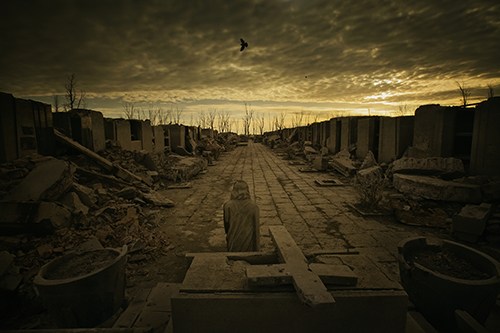
Photographer Adrián Markis is the Edge of Humanity Magazine contributor of this documentary photography. From the project ‘Epecuén’.
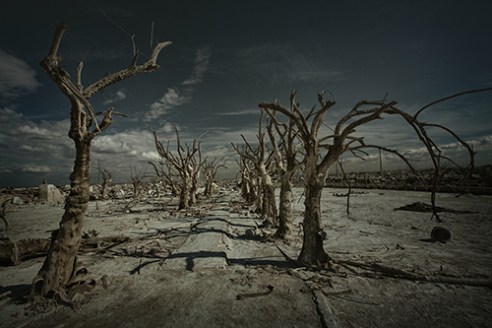
Epecuén Lake Village is located 550 kilometers southwest of Buenos Aires.
Epecuén’s famous lake belongs to the endorheic basin of the chained West Lakes system. These lakes are presumed to have been formed by the impact of the meteorite “Oblongos”. The system extends approximately 30 kilometers and is surrounded by a landscape of cultivated fields.
Epecuén is the sixth and last lake of the system, and has no outlet on the sea. It has always functioned as an “evaporating lake”, that means that the water that naturally entered into its shallow bed, basically from rain water and some streams, was evaporated by the action of the sun. Its minerals, salts and silt were deposited in its depths and after thousands of years helped to form the hypersaline qualities of the lagoon.
The first chemical analysis of water was undertaken in 1886, ten years after the founding of the town. It was then when it was confirmed that the salinity of the lake was above that of the sea at a rate of 10-1, ie, it has 340 g / l and the sea has 32 g / l. Its chlorides and sulphates are so high that, by means of physicochemical processes, they produce excellent results in rheumatic diseases, skin problems, anemia, diabetes, obesity, inflammation and scarring.
Epecuén’s waters are ranked first among all the mineral waters of the world. Its chemical composition is almost identical to the well known waters of Salies from Bearn and Biscours Biarritz (low Pyrenees).


During the early twentieth century, the lake began to be very famous for the curative properties of its waters. Sick people needed Epecuén, but there was a lack of infrastructure to host them; there was nothing else but water and salt. The government, following people’s complaints, began advertising campaigns, offering land on the lake in order to develop health tourism and medical treatments. Some pioneers and visionaries encouraged by the discovery, decided to invest fortunes in Epecuen, where they could forecast a prosperous future.
The growth became frenzied in few years. A major railway station with connections from three railway lines from all over the country was built. Major energy advances were made with the construction of a major power plant that gave light to the entire region. Mining industries that extracted the sulphate and sodium chloride to be used mainly in medicine were developed. Moreover, imposing upscale hotels were built to provide comfort and luxury to the wealthy families of Buenos Aires. Large spa resorts sprung up aiming to provide services to protect from the sun and offer showers to the tourists so they could wash off the salt attached to their bodies. Furthermore, a hydrothermal complex, bars, cafeterias, large private residences, a school, church and all the amenities of a small town were developed. Little by little the place turned into a great tourist town.
There was only one problem and this was precisely Epecuén’s lake itself.[…]
Continue reading: Epecuén | A Disastrous Story Of Economic Progress vs Nature

 msamba