
By Madeleine Muzdakis on March 5, 2021
In this case, the marshmallow was shrimp.
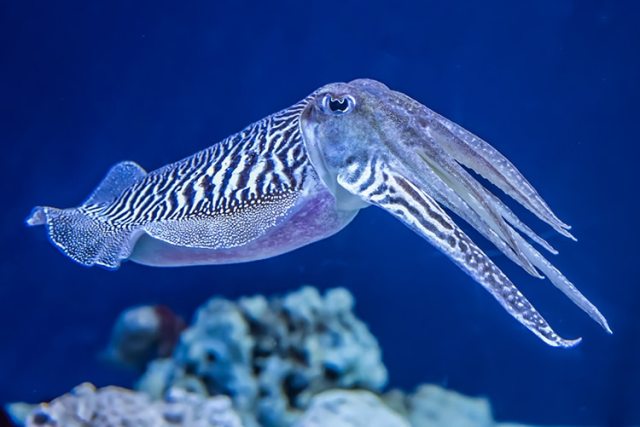 The common (European) cuttlefish (Sepia officinalis).
If you sat in front of a delicious marshmallow, would you be able to wait to eat it? What about if you knew that if you wait, in 15 minutes you could get two? This is the format of the famous Stanford marshmallow experiment, which was designed in the 1970s to test human children’s ability to delay gratification. Modified versions of the cognitive test have also been used by animal researchers to understand the capabilities of dogs, parrots, and other creatures. Recently, researchers publishing their findings in the Proceedings of the Royal Society B discovered that the common cuttlefish (Sepia officinalis) can exert self-control in a rendition of the marshmallow test designed for the tastes of cephalopods.
 The original marshmallow experiment tested children’s abilities for delayed gratification.
At a point in child development, humans learn to plan for the future. This skill enables them to control their impulses and delay eating the first marshmallow to wait for a larger reward. Other animals are capable of such planning when faced with similar situations. Dogs, primates, and corvids (birds) can pass the test. Scientists speculate that these species often need future planning skills to use tools, catch food, or form social bonds. However, the cuttlefish—a type of cephalopod—is a solitary creature that does not use tools. So, the researchers designed a unique “marshmallow experiment” using tasty treats which would measure the self-control of these creatures.
The experiment was carefully conducted; because cuttlefish cannot be told the rules, training was necessary to familiarize the fish with the reward structure. The team of researchers knew from a previous experiment that cuttlefish would not eat their breakfast of crab meat if they knew that doing so would result in a later dinner of (more delicious) shrimp. However, the team wondered if this was really self-control, or perhaps just an instinctual drive to get the best meal. In order to isolate self-control, a more elaborate “marshmallow test” was required.
The team took a new approach. Cuttlefish were divided into experimental and control groups. The marine creatures were all placed in tanks with two clear compartments that had treats behind clear doors. The cuttlefish were trained to recognize three symbols that indicated whether a door would open. A circle meant the door would immediately open while a triangle indicated a delay of between 10 and 130 seconds. A square meant the door would not open at all.
The results were impressive. In the experimental group, the cuttlefish were trained to realize that if they immediately ate the available prawn, they lost access to the more delicious shrimp behind the time-delayed door. Upon realizing this, the test subjects decided to exert self-control and wait for the tasty treat. In contrast, the control group participants were faced with shrimp behind a square door. Without training on how to access a treat, they chose to eat the prawn without waiting. This indicates that the cuttlefish in the test group were not simply following instinct but rather using cognitive abilities.
To follow up this discovery of the cuttlefish’s self-control, the team designed another experiment to test the creatures’ learning ability. Using a pair of gray and white squares, the cuttlefish were taught that approaching one color bought them a treat. Then, the meaning of the colors was switched. The cuttlefish which adapted fastest to this change were the same individuals who could wait longest for their reward in the “marshmallow test.”[…]
More: Cuttlefish Passed a Cognitive Test Originally Designed for Human Children

 msamba