
The 2021 Milky Way photographer of the year. Discover the best Milky Way images taken around the world in 2021!
“GRANTECAN” – ANTONIO SOLANO

- La Palma, Canary Islands – Spain
On the last night of my trip to La Palma, I went up to the “Roque de los Muchachos,” where I enjoyed a nice dinner with my girlfriend while watching the spectacular sunset over the sea of clouds that is typical of this location.
Moments later, the first stars were already visible and I set up my camera gear. The night was fantastic; there was no wind and no “calima” (haze) on the horizon. After several tests, I opted for a 50mm focal length that allowed me to capture a closer perspective of the telescope while framing our Galactic Bulge.
“HEAVENS ABOVE” – JOHN RUTTER
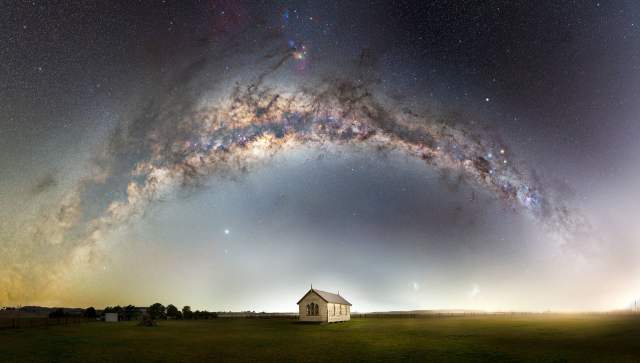
- Hunter Valley, NSW – Australia
This old church sits peacefully in a paddock in the Hunter Valley of NSW, Australia.
That night, the forecast was for terrible weather, so I had written the night off and went home. To my amazement, the skies cleared and it was a race to get back to the location and start shooting. As the fog started rolling in towards the end of the capture, a perfectly timed car drove past to illuminate the scene and the fog.
My passion is bringing the full Milky Way arch into people’s homes via large panoramas. I would encourage everyone to head out to a dark sky and experience it. Camera or not, it is a truly amazing sight to stand under the full arch of the Milky Way.
“DEVIL’S THROAT” – VICTOR LIMA
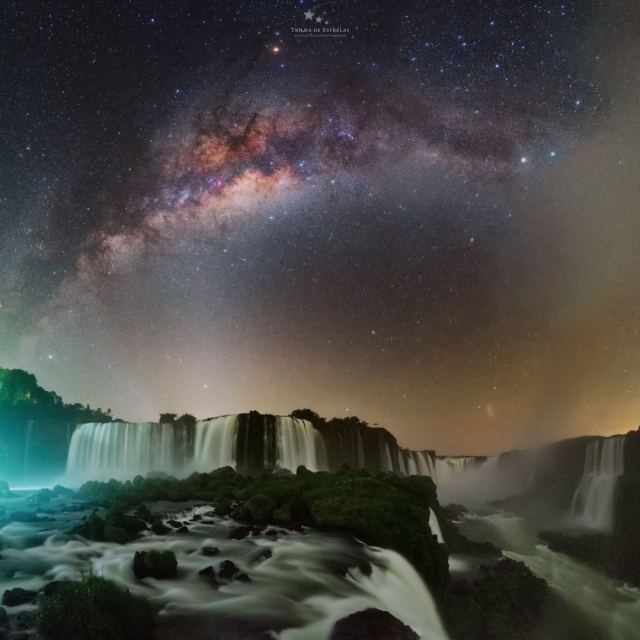
- Iguazu Falls, Brazil
Photographing Iguazu Falls at night has always been one of my priority projects. In order to do so, I needed to obtain a special authorization from the environmental agency that is responsible for national parks in Brazil.
Finally, in early 2021, I got this authorization and set out to put my plan into practice. I spent 4 days inside the Iguazu National Park with exclusive access to the Falls at night for my students and me. The first challenge was to walk around the park at night knowing that several jaguars live there, which are frequently seen by employees and tourists.
In the area closest to the main waterfalls, the big challenge was to make long exposure images with the strong water spray from the more than 1.5 million liters per second that fall through the waterfalls. Working with exposure times longer than 10 or 15 seconds became an almost impossible task and the lens was never dry.
In this image, we have one of the main waterfalls of the Iguazu Falls complex, the “Santa Maria Jump.” Right over the fall, we can see Saturn and the zodiacal light illuminating the horizon. Further up there is the Milky Way Core. We can also identify some of the main emission nebulae present in this region of the sky.
Much more: 2021 Milky Way Photographer of the Year – Capture the Atlas
Share this:
- Share on Facebook (Opens in new window) Facebook
- Share on Pinterest (Opens in new window) Pinterest
- Share on Tumblr (Opens in new window) Tumblr
- Share on Reddit (Opens in new window) Reddit
- Share on WhatsApp (Opens in new window) WhatsApp
- Print (Opens in new window) Print
- Email a link to a friend (Opens in new window) Email
- More

 msamba