
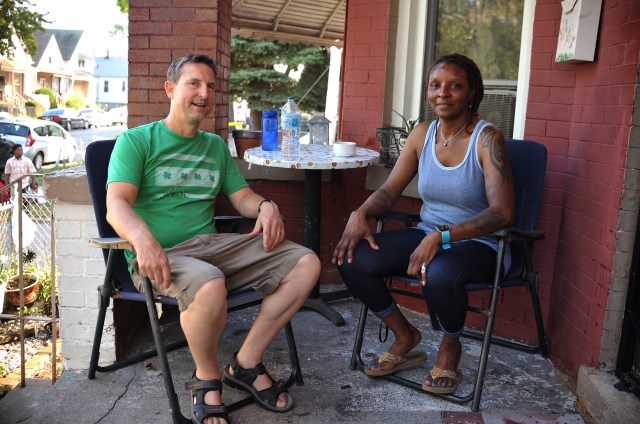
Colossal contributor Paulette Beete spoke with Tonika Johnson in November 2020 via phone. This conversation has been condensed and edited for clarity. Shown above is Wade, an Edgewater resident, sitting on Nanette’s porch in Englewood.
Though not Chicago’s true geographic center, the intersection of Madison Street, which runs east to west, and State Street, which runs north to south, is the central point for the city’s address system. Chicago native Tonika Johnson, however, has been viscerally aware that the north-south dividing line is not a mere postal distinction since she was a teenaged photographer.
Trained as a photojournalist, Johnson ultimately decided against going into the field, choosing instead to remain an enthusiastic—and skilled—hobbyist. In 2017, she was asked by neighbors to be part of a billboard project designed to show that Englewood’s residents were more than a set of crime and economic statistics. Inspired by the success of that undertaking, Johnson created the Folded Map Project, which uses photography as a starting point to explore the creation of segregated neighborhoods in Chicago, and the systemic racism in urban planning, real estate development, and resource allocation that has allowed that segregation to persist.
The basis of the project is Johnson’s stark photographs of map twins—that is, houses that have the same address but on different sides of the city. She initially had planned to display the map twin photos side-by-side, but as she met the people whose homes she was photographing, she decided to use her journalism skills to facilitate recorded conversations between the occupants.
The Folded Map Project is, in effect, a project about seeing past statistics to the actual people behind them. And once you get to know people, you can get to a place of empathy, which for Johnson is the starting point for creating lasting change. As she described, “What it comes down to in Chicago is that it’s so segregated that when we talk about locations and geography, we’re really talking about people. And that’s just the truth of it.”
Though the ongoing pandemic has limited Johnson’s ability to introduce more map twins to each other, she’s used the time to make a short film that explores the genesis of the project and what she hopes to accomplish. She also has developed Folded Map action kits, which she describes as “a self-guided way for people to participate in the project. It invites people to not only find their map twin but to run errands in (that twin neighborhood) and to share back the experience.”
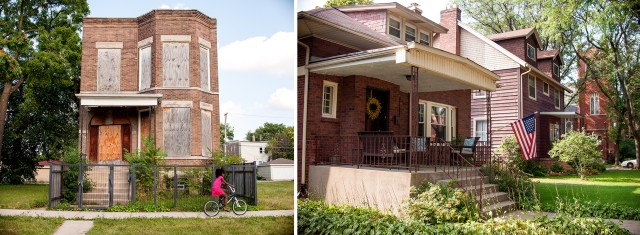 Left: 6329 South Paulina. Right: 6330 North Paulina
Paulette: How do you describe yourself as an artist?
Tonika: I only recently started calling myself publicly an artist. I was introduced to photography at the age of 13… so I was constantly looking and paying attention to everything. I used to joke with my friends that I wished I had a camera in my eye and that I could just take pictures with a blink. (laughing)
When I started college, my mentor, who was a photojournalist, advised me to major in something [that wasn’t photography] because he said, “you have an eye, and all you have to do is continue taking photos, and you’ll build a portfolio.” I still took as many photography classes as I could that were unrelated to journalism. Once I graduated, I was trying to decide [if I wanted to] be a staff photojournalist somewhere. In Chicago, I knew that at some point as a new photographer I was going to have to photograph crime. I knew that I was going to be sent right back to my neighborhood or neighborhoods like it. And I just didn’t want to photograph that at all. So I relegated my photography to being a hobby.
A couple of decades later, my neighbors had the amazing idea to rent five billboards in our neighborhood and…put messages and photos of the community on the billboards. All of them were like, “Tonika, you’ve been taking photos all this time. I know you have so many photos. (laughing) You should just be a part of the project.” We called that project the Englewood Rising Billboard Project. It started to get media attention in Chicago, and it was at that time that the news and fellow residents started calling me an artist. I said I guess I need to start calling myself an artist now since, you know, my community tells me, “No, that’s what you are. You’re not just a photojournalist.”
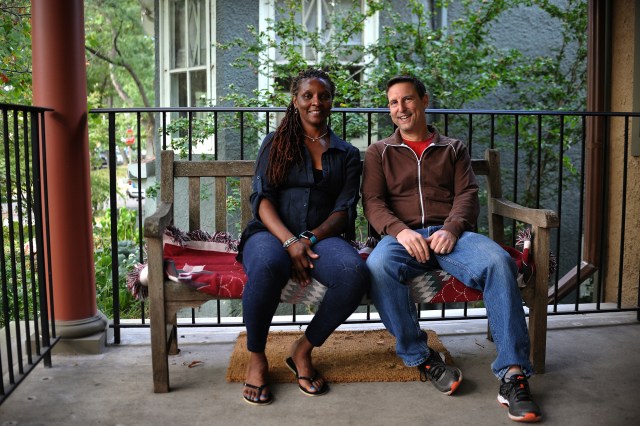 Nanette, an Englewood resident, sits on and Wade’s porch in Edgewater.
Paulette: I love that idea of being anointed by your community as an artist. I think that’s so powerful for your community to call out what they see in you. Your ongoing project, Folded Map, raises issues of equity and social justice. Can you talk about how you see that relationship between these issues and the arts and the way that initiating that conversation in the context of an art project can create a safe space for a discussion?
Tonika: As the film [about the project] reveals, it’s basically my life story. It’s an art project focused on the observations of someone that grew up in a segregated city. The ultimate point that I was trying to get across was that Chicago’s history of segregation is still with all of us today. I wanted to prove this point for people who might not make that connection [between] the disparity that exists and the history behind it. I wanted the project to be an entree into expanding people’s minds of Chicago’s history of segregation through thinking about their own lived experience. I really appreciated being able to do that through art, through photos and portraits and video because I wasn’t blaming people who live on these different sides. I was offering them insight into the larger question of, “did you really choose this? Does our segregation reflect how we want to interact? And if it doesn’t, then you have to question why is it this way?”
There is this narrative that people think [Chicagoans] don’t interact. But we do, a lot, especially through art. That’s how we know the city is segregated. (laughing) We know that we’re disrupting this segregation when we come together. And that’s why I think art is such a beautiful common denominator.
Regardless of whatever medium, if you are an artist, it is so easy for you to connect with another person that shares that same passion. You don’t care where they’re from. You don’t care if they create work that you find interesting. [If you respect their work as an artist], you’re going to want to get to know them. You’re going to start caring about things that impact the work that they make, how they make it. Art offers an opportunity of inquiry that I don’t think other areas provide. I think art is such a beautiful way to communicate that commonality and then offer an opportunity for people to understand more complex systemic issues. I think that that is something that other professions can benefit from, the sheer vulnerability that artists have when creating work, regardless of their different lived experiences. It creates a bond. And that bond transfers over to the viewer.[…]

 msamba