He has lived in a homeless hostel and dodged police to put his mark on the city, but now London-based graffiti artist Stik is invited all over the world to paint huge murals of stick figures, many of them offering social comment. Stik, who refuses to talk about much of his life on the street, showed BBC News around his studio and some of his favourite works. Video journalist: Dan Curtis
Physicist Matthias Kling studies photons and the things science can do with ultrafast pulses of X-rays. These pulses last just attoseconds – a billionth of a billionth of a second, Kling says. He uses them to create slo-mo “movies” of electrons moving through materials like those used in batteries and solar cells. The gained knowledge could reshape fields like materials science, ultrafast and quantum computers, AI, and medical diagnostics, Kling tells host Russ Altman on this episode of Stanford Engineering’s The Future of Everything podcast.
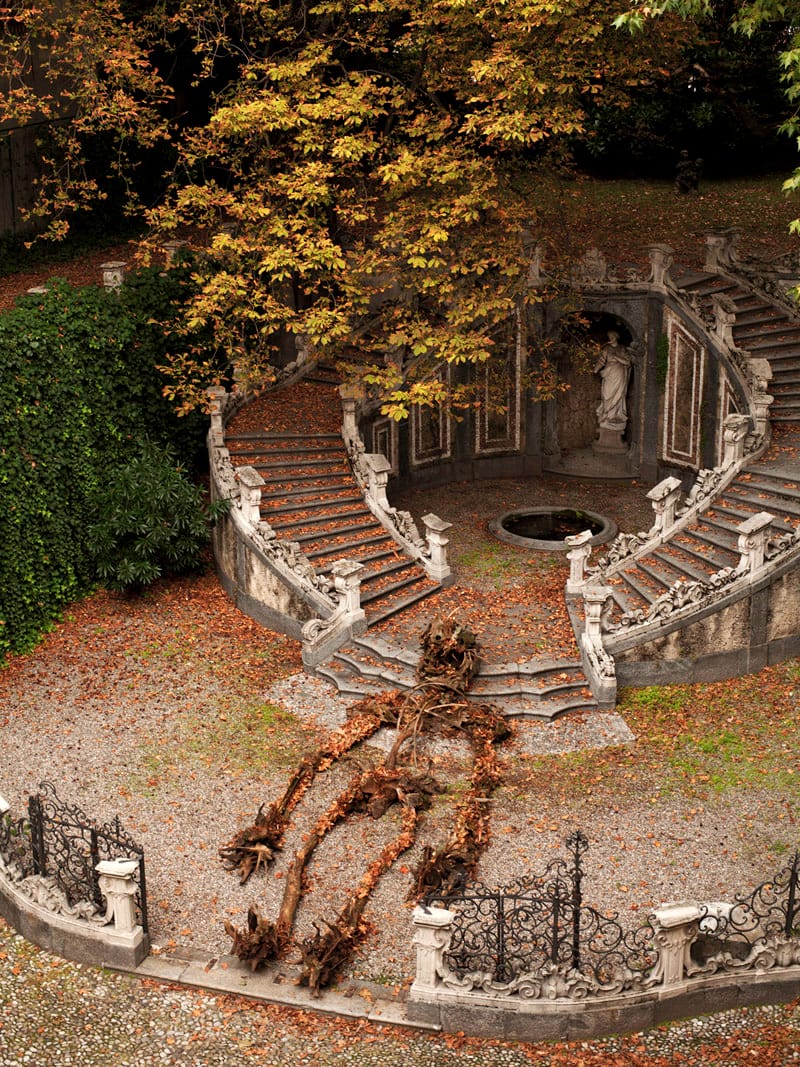
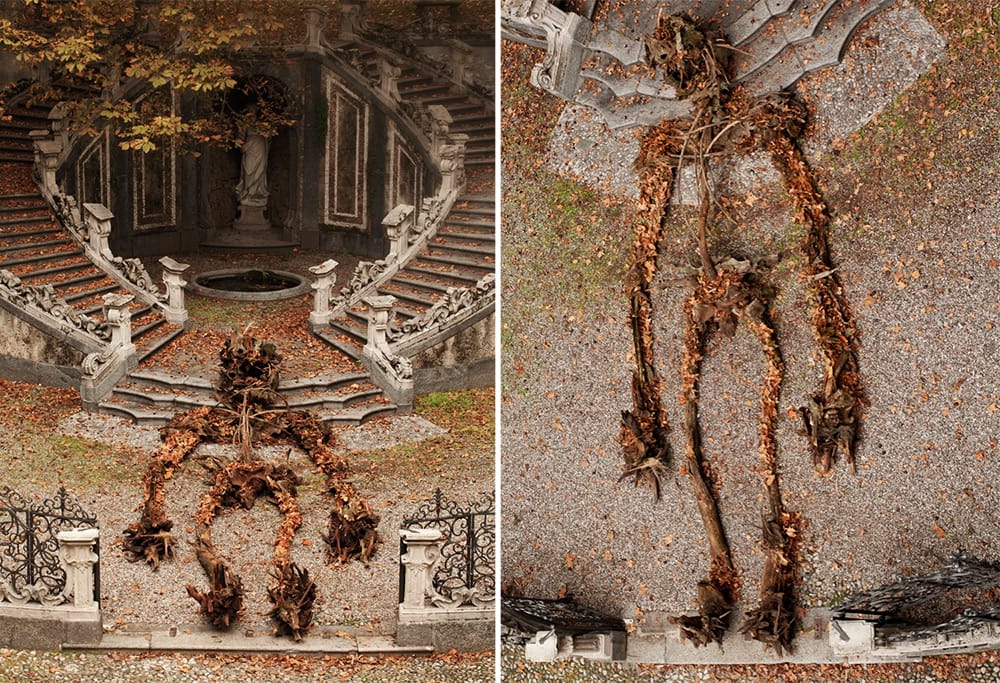
In this 2012 installation, artist Never2501 assembled a variety of found vegetation to form an eerie skeleton at the base of some steps in the idyllic gardens of the Museo Archeologico Paolo Giovio in Como, Italy. The piece was titled “In Cammino Per Trasformarsi Nell’istante Presente” (Moving to Transform into the Present) and could be interpreted as a harbinger of the seasons with the decaying root stumps and limbs pulled from a nearby forest, fit together without the aid of any additional materials. Or maybe it’s just an incredibly disturbing thing to stumble onto when walking through the woods?
You can see more photos of the temporary piece here, and follow Never2501’s more recent work on Instagram.
Physicists Rolf Ent from Jefferson Lab, Newport News, VA, and Richard Milner from MIT, together with animator James LaPlante from Sputnik Animation, Portland, ME, have created a 10 minute video that includes new animations of the atomic nucleus.
For the first time, the sizes, shapes and structures of nuclei in the quantum realm are visualized using animations and explained in the video. The work was made possible by funding from Jefferson Lab.
Go to https://www.planetary.org/epic to become a member of The Planetary Society, joining their mission to increase discoveries in our solar system and beyond, elevate the search for life outside our planet, and decrease the risk of Earth being hit by an asteroid. They’re an awesome team over there and I’m so pleased they chose me to partner with.
Otherwise thanks everyone for being a part of this channel, similar to my previous videos I spent more than four months on this one and I’m so pleased to be able to finally share it! I couldn’t have done it without the sea of encouragement I get on these videos. If you’ve liked, subscribed, shared or just enjoyed these videos I’m incredibly thankful and I hope you liked this one too. If you’d like to support me further I do have a Patreon at / epicspaceman
In many ways this video is an homage to the Hubble Deep Field image and the profound answers it brought us about the scale of what’s out there.Taking the image was certainly not a foregone conclusion either, Bob Williams was the director of the Space Telescope Science Institute and was pretty much the only person interested in using so much of Hubble’s time imaging ’emptiness’. But he persisted and as he was the director he had a discretionary amount of time he could point Hubble at anything so he ignored everyone, threatened to quit if there wasn’t anything interesting in the image and forged ahead! Thanks Bob!
For those interested in the technicals of how I made this, I make these videos on my own and it’s all done in the free (and wonderful) 3D software Blender, if you look at my video ‘Who is Epic Spaceman?’ I talk about it there along with my background: • Who is Epic Spaceman?
This video was relatively tricky due to the number of pieces of cereal or galaxies I had to render at times. I think for the shot where I’m ‘underwater’ surrounded by galaxies I had about a million around me which got my computer sweating a bit! I had to make the galaxies slightly smaller than they should be for that shot because otherwise it was just a sea of white light. It was certainly a challenge getting the scale of what 200 Billion really looks like but for this one I really enjoyed adding in the part about how and why we know this stuff. There are so many wonderful stories in science about how we know things.
Anyway, I hope you all enjoyed it, I’m still working on another about exoplanets but I have a few others in the works too. Thanks again for the support everyone!
Music and SFX was all from Artlist:
Ardie Son – Infinite Circles
TURPAK – Exceptional
Martin Puehringer – Outside
Andreas Kubler – Glory Days
C.K. Martin – Arise a Legend
Lux-Inspira – Liberation
Letra – Echoes
Letra – Restless Sea
ELT model CC attribution: idimarco77
Moon Mosaic image CC attribution: KnightFallV