The ocean is a giant, complex machine that drives the world we live in – and we ignore it at our peril. Find out why with 2020 Christmas lecturer Helen Czerski.
Watch the Q&A here: • Q&A: How does the ocean help shape ou…
Buy Helen’s book ‘Blue Machine’ here: https://geni.us/QRid
Discover the rich diversity of life and movement in our oceans, from ancient navigators to permanent residents of the deep. Explore the vast currents, invisible ocean walls, and underwater waterfalls that shape our oceans’ complex systems. Understanding the workings of the global ocean system is essential now that it is under significant threat, so we must put this knowledge to use in order to save our blue machine.
With her passion and expertise in marine science, Helen offers a thrilling and captivating account of our oceans’ intricate workings and its significance to our future. Don’t miss this opportunity to gain a deeper understanding of our oceans and their fundamental role in our world.
This talk was filmed at the Ri on 1 June 2023
Helen Czerski is a former Christmas Lecturer, physicist and oceanographer with a passion for investigating the interesting things in life. Helen graduated from the University of Cambridge in 2001 with a first in Natural Sciences (Physics), and in 2006 with a PhD in experimental explosives physics.
In 2010, Helen returned to the UK after four years spent working in the USA at the Scripps Institution of Oceanography and URI’s Graduate School of Oceanography. Her academic home now is the Department of Mechanical Engineering at University College London, where she studies the physics of breaking waves and bubbles at the ocean surface.
As a regular science presenter on the BBC for ten years, Helen has covered the physics of the natural world in BBC2 landmark documentaries, and of everyday life in a range of BBC4 documentaries. Helen is also a regular contributor to Horizon, and most recently she presented the BBC show ‘Ocean Autopsy’, examining the damage that humans have caused to the ocean and its habitants.
It was a joy making this film for the CO OP. It’s always exciting facing a new creative challenge – and it was fun to set the rule, what if we print every frame through a receipt printer? Every frame of animation was printed, cut and filmed in stop-motion to create the final film. I love how it turned out! Thanks to the incredible team of incredibly talented people.
Production Company: @blink_ink
Director Sam Gainsborough
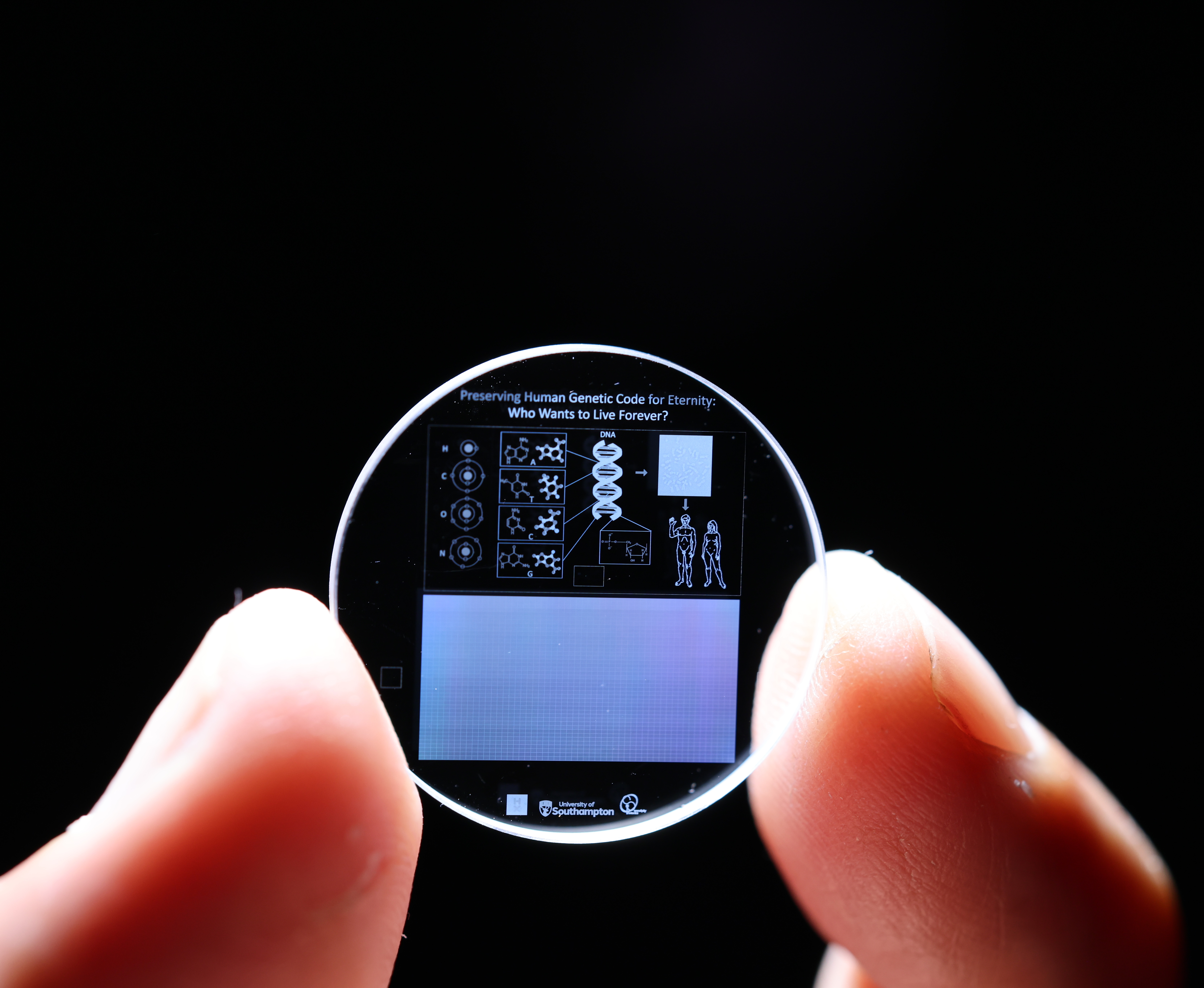
University of Southampton scientists have stored the full human genome on a 5D memory crystal – a revolutionary data storage format that can survive for billions of years.
The team hope that the crystal could provide a blueprint to bring humanity back from extinction thousands, millions or even billions of years into the future, should science allow.
The technology could also be used to create an enduring record of the genomes of endangered plant and animal species faced with extinction.
Eternity crystals
The 5D memory crystal was developed by the University of Southampton’s Optoelectronics Research Centre (ORC).
Unlike other data storage formats that degrade over time, 5D memory crystals can store up to 360 terabytes of information (in the largest size) without loss for billions of years, even at high temperatures. It holds the Guinness World Record (awarded in 2014) for the most durable data storage material.
The crystal is equivalent to fused quartz, one of the most chemically and thermally durable materials on Earth. It can withstand the high and low extremes of freezing, fire and temperatures of up to 1000 °C. The crystal can also withstand direct impact force of up to 10 ton per cm2 and is unchanged by long exposure to cosmic radiation.
The team at Southampton, led by Professor Peter Kazansky , use ultra-fast lasers to precisely inscribe data into nanostructured voids orientated within silica – with feature sizes as small as 20 nanometres.
Unlike marking only on the surface of a 2D piece of paper or magnetic tape, this method of encoding uses two optical dimensions and three spatial co-ordinates to write throughout the material – hence the ‘5D’ in its name.