Go to https://ground.news/joescott to get 40% off unlimited access to the news tool I actually trust. It helps you cut through the noise and understand how stories are being reported across the spectrum.
There are many things in this world that seem simple but are actually insanely complex and took humanity thousands of years to figure out. Take, for example, the screw. Even though people have been using threaded machines to do work since the ancient Greeks, what we think of as the screw only came into existence in the last couple hundred years. But once it did, it changed everything.
TIMESTAMPS
0:00 – Intro
1:42 – History of the Screw
3:04 – Ancient Construction
5:42 – Standardizing Screws
9:54 – Other Examples
13:46 – Sponsor – Ground News
London’s development along the banks of the Thames has been shaped by countless forces through the millennia, from transit to economics to the maintenance of particular views—but never modern “zoning” laws. In this episode of “A View on Cities,” KPF Principal John Bushell, RIBA, walks us down the famous river to explore how the ancient capital’s built form came to be.
0:00 Welcome to a Sunny London
0:26 The Picturesque City
1:37 The Polycentric City
2:04 Transit-Oriented Density
3:00 North London, South London
3:44 Artists and the Thames
4:25 Southwark and Southbank Tower
5:38 London Old and New
As part of #KPF50, “A View on Cities” offers an in-depth look at the challenges and opportunities defining global cities today. Drawing on KPF’s expertise in contextual and high-performance design, the series investigates how thoughtful urban architecture can drive the resurgence, reinvention, and resilience of the places we live and work.
At Windsor Castle, a one-of-a-kind architectural marvel isn’t a structural part of the building itself or even a full-size feature. Here, you’ll find Queen Mary’s Dolls’ House, widely regarded as the largest and most famous in the world. Designed by architect Sir Edwin Lutyens, the house was built between 1921 and 1924 and contains items and furnishings conceived of by hundreds of the leading craftspeople and artisans of the day.
Queen Mary, consort to King George V between 1910 and 1936, was an enthusiast of all things miniature. Her dolls’ house even contains scale versions of nearly 600 real books in its library, including works by literary giants like A.A. Milne and Sir Arthur Conan Doyle. Commissioned from publishers around the U.K. and farther afield, many of these books are also held in the collections of the V&A, where they have been on long-term loan since 1916.
A recent video produced by the museum glimpses some of these tiny treasures with the expert guidance of National Art Library Assistant Librarian Amy McMullan and Catherine Yvard, Curator of National Art Library Collections. Examples include a red leather-bound Bible published in 1896 by Glasgow-based David Bryce & Son, in addition to a Quran, a collection of poems by Robert Burns, and more.
The National Art Library is housed within the V&A, and more than a million publications related to art, design, and performance comprise an archive that spans the 8th century to today.
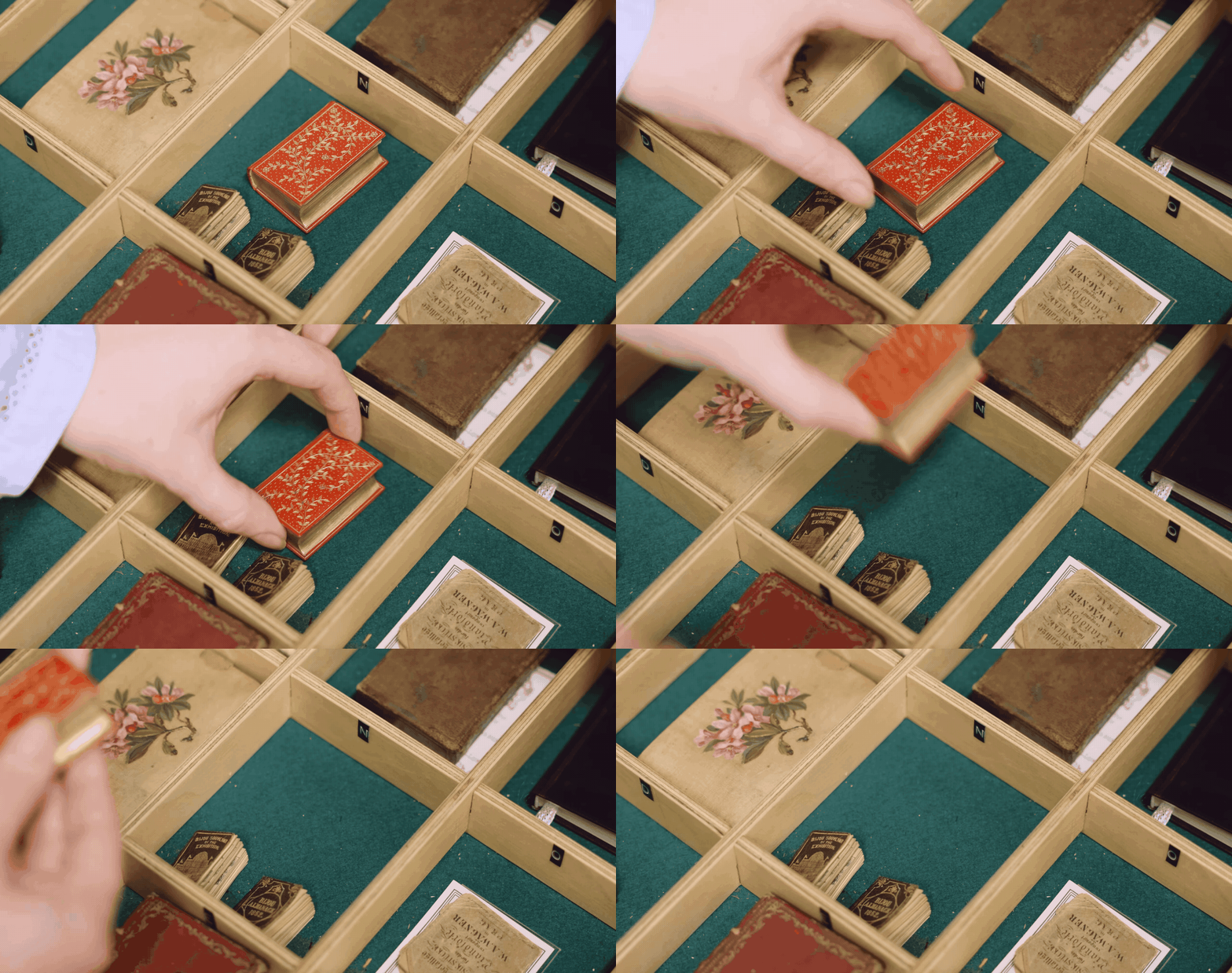
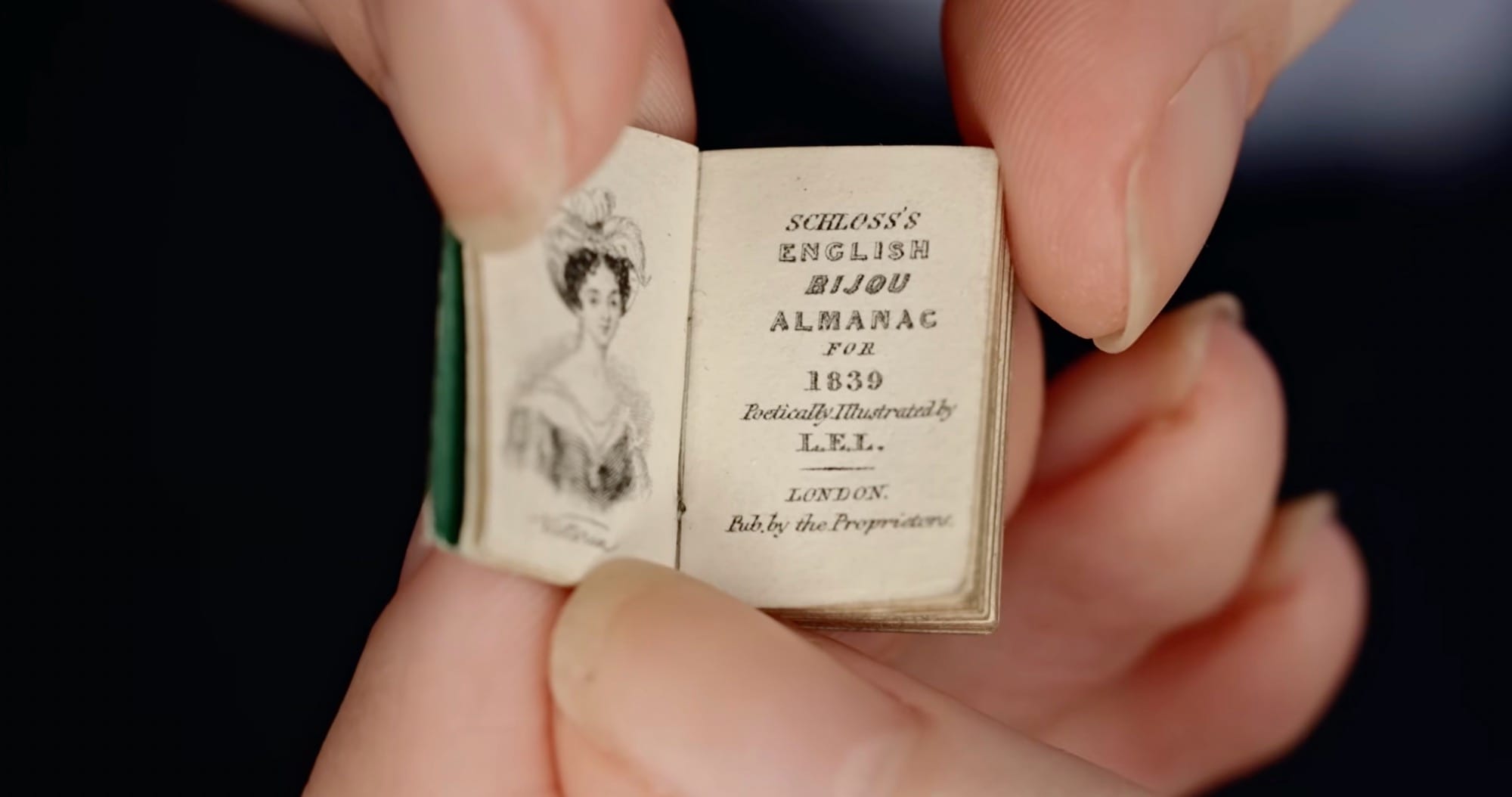
Many more miniature books comprise the museum’s holdings, in addition to Queen Mary’s collection. Little almanacs in their embellished folios were published annually and included notable dates, such as sunrises and sunset times, holidays, and other practical information. Many of the titles sport gilt edges, marbled papers, and even metal cases that double as lockets so that they could be worn.
The collection includes diminutive dictionaries, a souvenir of The Great Exhibition of 1851 in Hyde Park, and children’s books—including a number of tunnel books, or paper peep-shows. These accordion-style tomes look at first glance like any other publication, but they expand into long tunnels through which viewers can take in a layered, dimensional scene. […]

 msamba