Mother is SHOCKED when Daughter Starts Singing In Public

[…]

First song:

• Amy Winehouse – Valerie (Sung By Josh)
2nd song:

• Ella Eyre – We Don’t Have to Take Our…

Here I am asking random people to sing in NYC, and a lot of people are saying. But Josh says yes! He is on his way to a concert. But little did he know, he would put on a concert for his friend right on the street!

Also met Signe who sings the second song. At first she seems a little shy, but her family encourages her to sing. As she sings, she gets more comfortable and her family watches in amazement!

As a musician, I’m all about creating musical experiences that have people feeling happy and free, and that’s why the “Sing With Me for Free” series exists. Since 2018, I have asked thousands of random people to sing with me on camera. A lot of people have said no, some have said no initially but changed their minds to yes, and some have said yes right away. I ask these people to sing with one purpose: to create a way for them to experience a sense of happiness and freedom they did not feel before. And much of the time, this actually works (and that makes ME happy).

► Join the Patreon channel for behind the scenes content:

/ guitaro5000

For all business/general inquiries, please email guitaro5000@rightclick.gg

For behind the scenes content please subscribe to my Patreon page.

/ guitaro5000

[…]
Posted in Music | Tagged , , , , | Leave a comment

Emilio Piano ft. Lucie – Voilà (Barbara Pravi cover)

Posted in Art | Tagged , , , | Leave a comment

How Did Egyptians Build Pyramids? New Study Suggests Answer | My Modern Met

By Madeleine Muzdakis on May 30, 2024

hoto: MANJIK/Depositphotos

People have long wondered how ancient Egyptians managed to build the pyramids in Giza. Researchers may finally have an answer.

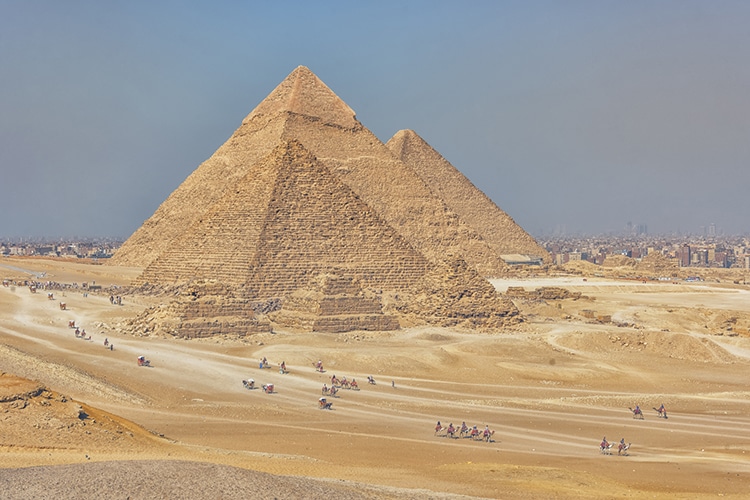
The pyramids have stunned onlookers for centuries. The Great Pyramid of Giza, in particular, is one of the seven wonders of the ancient world—and the only one still standing for modern eyes to observe. Giza, Egypt, is home to the Great Sphinx and pyramids enshrouding ancient pharaohs. A cluster of 31 pyramids in the desert region has always presented a difficult question: how did ancient architects build these monuments, with millions of hewn stone blocks weighing multiple tons each? While archeologists have long speculated that ancient Egyptians used water to carry the weight of the blocks, a new study has illuminated a forgotten branch of the Nile River that adds the missing link.

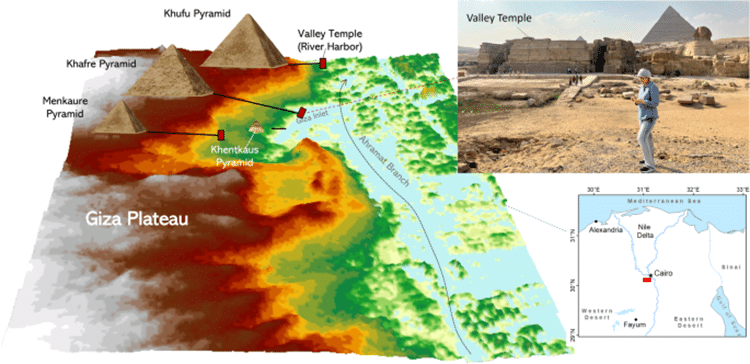
Pyramid causeways and the Giza Inlet. (Photo: Author Eman Ghoneim/Ghoneim et al.)

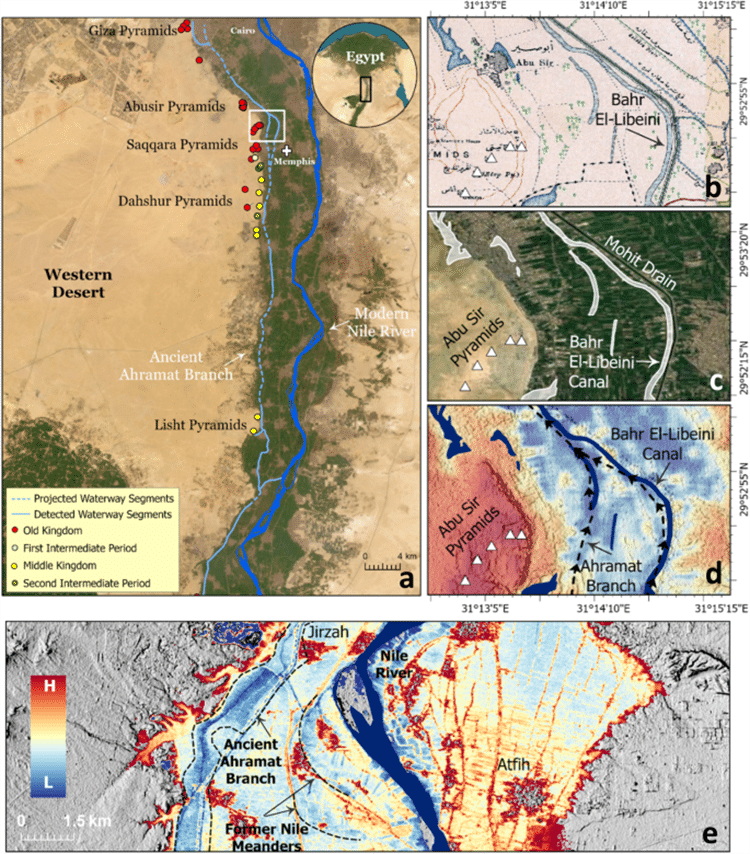
Researchers from the University of North Carolina Wilmington, in their own words, used “radar satellite imagery, in conjunction with geophysical data and deep soil coring, to investigate the subsurface structure and sedimentology in the Nile Valley next to these pyramids.” They were therefore able to investigate the landscape throughout time, seeing how it has evolved into the dry sand-covered plain it is today. They discovered the presence of an ancient, buried riverbed that once ran alongside the 31 pyramids. Named the Ahramat branch, after the Arabic word for pyramids, this waterway was an offshoot of the Nile that ran for 39 miles and stretched up to about 2,296 feet wide. This powerful waterway is likely how the ancient builders floated their blocks of stone, teams of workers, and other cumbersome transports to the sites of the pyramids.

“Nobody was certain of the location, the shape, the size or proximity of this mega waterway to the actual pyramids site,” study author Professor Eman Ghoneim told the BBC. The pyramids in the region were constructed between 3,700 and 4,700 years ago, while the river branch was flowing. Eventually, the river branch would be buried under the desert. The Ahramat Branch is not the only ancient path of the Nile’s waters to be discovered by archeologists, according to the paper. Uncovering ancient waterways explains the locations of structures and movement of ancient peoples.[…]

Depiction of the ancient Ahramat Branch on modern maps. (Photo: ESRI World Image Basemap, source: Esri, Maxar, Earthstar Geographics/Ghoneim et al.)

Source: How Did Egyptians Build Pyramids? New Study Suggests Answer

Posted in Technology | Tagged , , , | Leave a comment

Who Invented Soft Drinks?

[…]

This video is #sponsored by UPDF.

Love content? Check out our other YouTube Channels:

Higher Learning:

/ @higherlearningflight
Flick Facts:

/ @flickfacts
Fact Quikie:

/ @factquickie
Ancient Marvels:

/ @ancient-marvels
Origins:

/ @originsofeverything
Warographics:

/ @warographics643
MegaProjects:

/ @megaprojects9649
SideProjects:

/ @sideprojects
Into The Shadows:

/ intotheshadows
Highlight History:

/ @highlighthistory
Brain Blaze:

/ @brainblaze6526
Casual Criminalist:

/ thecasualcriminalist
Decoding the Unknown:

/ @decodingtheunknown2373
Places:

/ @places302
Astrographics:

/ @astrographics-ve4yq

[…]

Posted in Design | Tagged , , | Leave a comment

Battle for Comet 1847T1

[…]

Maria Mitchell: Life, Letters, and Journals (the medal correspondence is in the appendix at the end): https://www.gutenberg.org/cache/epub/…

Subscribe to my channel to see more videos like this: https://www.youtube.com/user/tibees

[…]

Posted in Astronomy | Tagged , , | Leave a comment

What Does An Electron Look Like

Posted in Science | Tagged , , | Leave a comment

Wharton professor: 4 scenarios for AI’s future | Ethan Mollick

Wharton professor Ethan Mollick explains why “co-intelligence” may be the future of AI.

Subscribe to Big Think on YouTube ►

/ @bigthink
Up next, Debunking doomerism: 4 futurists on why we’re actually not f*cked ►

• Debunking doomerism: 4 futurists on w…

Ethan Mollick, professor at the Wharton School of the University of Pennsylvania and author of “Co-Intelligence: Living and Working with AI,” explores the impact of AI on our work, creative endeavors, and overall lives.

AI is reshaping our understanding of humanity and intelligence, evolving from simple prediction tools to sophisticated large language models, but how do we keep it from dooming us all? Should we be more afraid of it, or are we actually in control? Mollick proposes four most likely predictions of our future with AI – As Good As It Gets, Slow Growth, Exponential Growth, and The Machine God – and explains the likelihood and potential results of each one.

Mollick stresses the importance of using AI as a supplemental tool to enhance your performance, not as something that will replace you entirely. According to Mollick, AI is here to stay, and it’s up to us to decide how it is used now, and in generations to come. Our choices today will shape the trajectory of AI and determine whether it becomes a force for good or a source of existential risk.

Read the video transcript ► https://bigthink.com/series/the-big-t…

[…]

Posted in Technology | Tagged , , | Leave a comment

Brasil, Brasil – Samba to Bossa Nova (1of4)

BBC Four Documentary

Quote
Comprehensive review of Brazilian music in a three-part series which tells the story of the styles and the artists that have captured the world’s imagination for decades. This edition covers the history of samba, from the early days of slavery to flamboyant stars like Carmen Miranda and Elza Soares, and shows how samba’s off-shoot bossa nova went global back in the early 1960s. Featuring specially-shot performances, interviews and rare archive footage.
Unquote

From http://www.bbc.co.uk/programmes/b008byj6

[…]

Posted in History | Tagged , , , , | Leave a comment

The Original Secret History

To receive my first catalogue, ‘Secret Histories’ join my mailing list here: https://www.tomwayling.co.uk/register

This is the story of Procopius’s Secret History Of Justinian – originally written around 550, but not published until 1623.

In this video we look at how Procopius wrote the text, how it survived, almost unknown, for 1,000 years, how it came to be published in the 1620s, and the extraordinary ramifications when it was.

00:00 Introduction
00:44 The Original Composition Of The Secret History
02:40 The Survival Of The Text In Greek Manuscripts
05:56 The Rediscovery And Publication Of The Secret History
08:23 Secret Histories Go Viral

To learn more about Secret Histories, sign up to receive my catalogue of rare books devoted to the subject – https://www.tomwayling.co.uk/register

I couldn’t have made this video without the help of two works in particular. The first is Brian Croke’s magisterial Procopius: From Manuscripts To Books: 1400-1850. The second is The Secret History In Literature, 1660-1820 which is edited by Rebecca Bullard and Rachel Carnell.

My name’s Tom and I’m an antiquarian bookseller – you can browse the books I have for sale on my website: https://www.tomwayling.co.uk/

[…]

Posted in Literature | Tagged , , | Leave a comment

Where Does “Yes” Come From? #etymology #essentialetymologies

Posted in Language | Tagged , , | Leave a comment