Engineering Humans for Deep Space with Ronke Olabisi

What happens to the human body in deep space? Neil deGrasse Tyson and co-hosts Chuck Nice and Gary O’Reilly explore tissue engineering, Wolverine & Deadpool’s healing style, and the science that could help humans adapt to long-term space travel with biomedical engineer Ronke Olabisi.

We talk about the 100 Year Starship Project and the importance of attempting the impossible. We beg the question: if we lived our whole lives on a spaceship, what would we need? What questions have we not thought to ask? Ronke explains the basics of tissue engineering and its important role in preparing humans for long term space travel.

What happens if you need a heart transplant or suffer severe burns while on a mission to Mars? Learn the possibilities of tissue engineering in space. Find out about how we could grow organs and bones, and even heal wounds, without scarring. We dive into mechanical organs versus bioengineered ones to the idea of genetically upgrading space travelers. Plus, who’s healing style is more realistic: Wolverine or Deadpool?

Could we bioengineer astronauts to withstand the rigors of space? Learn about the effects of microgravity on bone density, and the mysterious ways space affects our eyesight. Could we make humans resistant to radiation? Could we one day see a future where humans are specifically engineered for life in space? Join us as we explore the boundary between science fiction and science fact.

Timestamps:
00:00 – Introduction: Bioengineering in Space
3:24 – The 100-Year Starship
8:33 – Tissue Engineering for Space
13:25 – Mechanical vs. Biological Organs
17:54 – Injuries in Space
22:27 – Wolverine vs. Deadpool
27:50 – Effects of Microgravity
34:25 – Radiation Resistance
38:54 – Bone Density in Microgravity
47:00 – Other Biological Solutions to spaceflight

[…]
Posted in Science | Tagged , , | Leave a comment

A Deep Dive Into The Bizarre Future of Telescopes

Hoping to see deeper into the universe, scientists and engineers are designing some of the largest and weirdest telescopes ever conceived. Come with our guest host Astro Alexandra on a tour of the telescopes of the future.

Hosted by: Astro Alexandra

[…]

Posted in Astronomy | Tagged , , , | Leave a comment

Heart-shaped amethyst geode discovered by miners in Uruguay

Posted in Nature | Tagged , , | Leave a comment

Glasgow Subway is one of the smallest subways in the world.

Posted in transportation | Tagged , , | Leave a comment

Crafty Acacia Holds Ants Hostage With Addictive Reward! 🧠🐜

Posted in Nature | Tagged , , | Leave a comment

Why do we call blue ‘blue’ when in other languages it’s like ‘azure’?

Why do we call blue ‘blue’ in English? And what can a gallery tell us about a very special name for the colour in other languages?

I was one of 20 Creative Collaborators across the country selected to make social media content for the National Gallery’s 200th birthday. I wanted to go a step further and turn it into a film – my first of hopefully many on the stories of language and colour. You can find out more about the commission here: https://www.nationalgallery.org.uk/ab…

Some languages have a blue colour term that comes from neither blao nor lāžward. What do you call it in your language?

Filming: Alessandro Sorenti
Produced and edited by me

This was the first film in Language and Colour. What colour should I do next – and where should I do it?

Sources:
https://eragem.com/news/history-egypt…
• COLOUR WORDS: The astounding origins …
• Why Is Blue So Rare In Nature?
The Colour Code by Paul Simpson
The Secret Lives of Colour by Kassia St Clair
Silk Road Map by Kevin Case

[…]


Posted in History | Tagged , , , | 1 Comment

Portland Art Museum now offers colorblindness glasses

isitors to the Portland Art Museum who have red-green color blindness can now borrow glasses that will enhance the colors they see inside the museum.

[…

Posted in Art | Tagged , , | Leave a comment

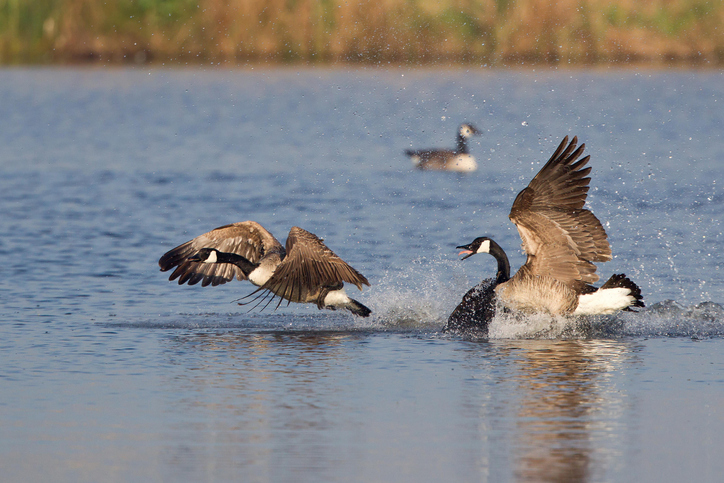
What Exactly Is a ‘Wild Goose Chase’?

By Paul Anthony Jones |Aug 13, 2024

No wild geese were harmed in the making of this idiom.

It’s easy to presume that when you describe something as being like a wild goose chase, what you really mean is that it’s as futile or as difficult as chasing after and catching a wild goose. But, strictly speaking, that’s not the case. The original wild goose chase didn’t have anything to do with chasing wild geese. Rather, it involved chasing after someone (or, as the case may be, being chased yourself) like a wild goose.

What has long been credited as the earliest written record of a wild goose chase (more on that in a minute) came from William Shakespeare’s Romeo and Juliet, written sometime in the early-to-mid 1590s. Mercutio says to Romeo:

“Nay, if our wits run the wild-goose chase, I am done, for thou hast more of the wild-goose in one of thy wits than, I am sure, I have in my whole five. Was I with you there for the goose?”

Mercutio is complaining about losing a battle of wits (part of a conversation that includes one of Shakespeare’s dirtiest jokes) to Romeo while they wander the streets of Verona waiting to meet with Juliet’s nurse. And here, he’s seemingly comparing their “hunt” for the perfect one-liner in their jibing, back-and-forth conversation to what appears to be an actual goose hunt.

Because this was thought to be the phrase’s earliest written record, the origin of wild goose chase has long been credited to Shakespeare and merely chalked up to just another of his many literary inventions. But it’s more likely that Shakespeare was playing on an already established term that has its roots in hunting with horses, not hunting birds.

Take a look at these lines from a poem, “The Mother’s Blessing,” by the English writer Nicholas Breton, written in 1602:

“Esteeme a horse, according to his pace
But loose no wagers on a wilde goose chase”

Although Breton wrote this poem as much as a decade after Shakespeare had completed Romeo and Juliet, it’s thought Breton’s work alludes to the phrase’s original meaning. Originally, a wild goose chase was a horse race in which a leading rider would head off into a field and make an especially challenging, winding course through the surrounding land. A second rider would then have to follow, retracing the first rider’s steps exactly and copying his every twist and turn, no matter how difficult, as they chased after him. A third rider would then set out after the second, and then a fourth and so on, until an entire group of riders was tracking one another through the countryside, all retracing the leader’s steps. […]

More: What Exactly Is a ‘Wild Goose Chase’?

Posted in English | Tagged , , | Leave a comment

Neil deGrasse Tyson & Janna Levin Answer Mind-Blowing Fan Questions

Is gravity fundamental to the universe? Neil deGrasse Tyson and Chuck Nice explore quantum physics, the fourth dimension, whether H2O is water, and the many-worlds interpretation with theoretical cosmologist Janna Levin, PhD.

Is space infinitely elastic? If spacetime is a particle at the smallest scales, is there space between spacetime? We get philosophical: is H2O water? We explore the quantization of space, Planck lengths, and whether gravity is an emergent feature of quantum physics. Is gravity a fundamental feature of the universe?

What would you see in the earliest parts of the Big Bang? We explore how you could rewrite relativity as particle field theory and the geometry and topology of the universe. Learn about the time Einstein let his driver give a talk for him and how the 1919 eclipse changed physics forever.

We break down the fourth dimension, compactifying space, and Lorentz boosts. Do physics and math view spacetime differently? Neil and Janna discuss the many-worlds interpretation and whether it’s trying to make classical sense of something non-classical. Plus, we explore how quantum teleportation would work. Is the universe in a superposition? Are black holes fundamental particles?

Thanks to our Patrons Mikal Krane, Tramond Spencer, John R, Laura Morrison, Javier Mejia, Emilio Campín Ramírez de Arellano, Jeff Gauthier, Tom Jones, and Jaired H for supporting us this week.

[…]

Posted in Science | Tagged , , | Leave a comment

This flower is called “Queen of the Night.” It blossoms only at night and only one night a year.

Posted in Science | Tagged , , , | 3 Comments