Is gravity fundamental to the universe? Neil deGrasse Tyson and Chuck Nice explore quantum physics, the fourth dimension, whether H2O is water, and the many-worlds interpretation with theoretical cosmologist Janna Levin, PhD.
Is space infinitely elastic? If spacetime is a particle at the smallest scales, is there space between spacetime? We get philosophical: is H2O water? We explore the quantization of space, Planck lengths, and whether gravity is an emergent feature of quantum physics. Is gravity a fundamental feature of the universe?
What would you see in the earliest parts of the Big Bang? We explore how you could rewrite relativity as particle field theory and the geometry and topology of the universe. Learn about the time Einstein let his driver give a talk for him and how the 1919 eclipse changed physics forever.
We break down the fourth dimension, compactifying space, and Lorentz boosts. Do physics and math view spacetime differently? Neil and Janna discuss the many-worlds interpretation and whether it’s trying to make classical sense of something non-classical. Plus, we explore how quantum teleportation would work. Is the universe in a superposition? Are black holes fundamental particles?
Thanks to our Patrons Mikal Krane, Tramond Spencer, John R, Laura Morrison, Javier Mejia, Emilio Campín Ramírez de Arellano, Jeff Gauthier, Tom Jones, and Jaired H for supporting us this week.
n this episode I trace the punctuation we use every day as far back as I can.
❓Is the question mark actually a word?
❗️Where did the exclamation mark come from?
🔴 Is the full stop the oldest punctuation?
🏛️ What punctuation did the Romans use?
These questions answered and more as we explore the origins of punctuation.
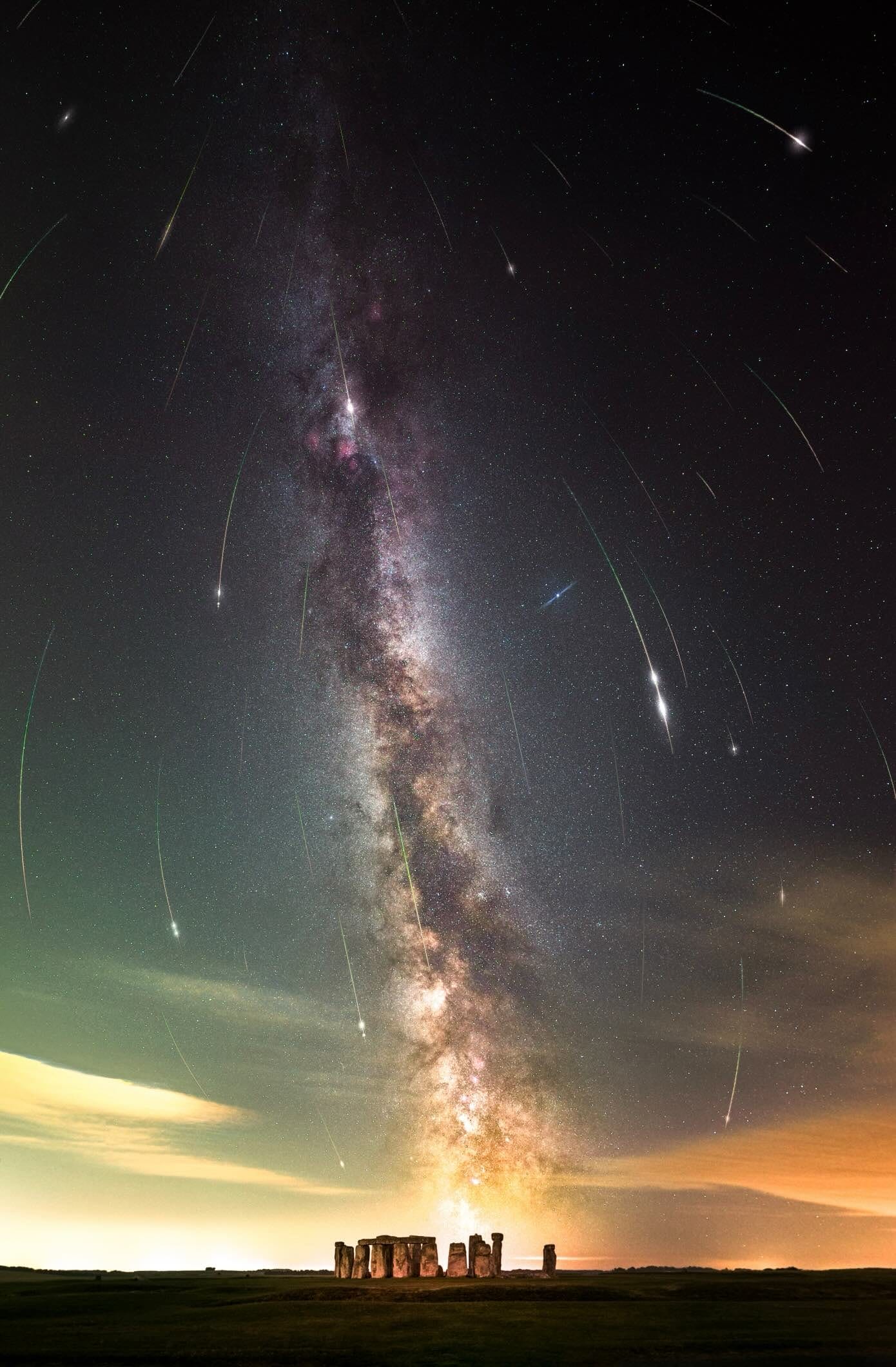
One of the brightest and densest meteor showers of the year, the Perseids pour down every August, leaving glowing streaks in their wake. Photographer Josh Dury captured this year’s stellar spectacle near Stonehenge, showing the fireballs illuminating the sky above the prehistoric grounds in Wiltshire, England.
On August 9, Dury camped out at the ancient monument—which aligns the sunrise on the summer solstice and the sunset on the winter solstice—to capture 46 images he later stitched together into the stunning composite above. Between 50 and 100 meteors are typically visible per hour when the Perseids arrive, and the photographer spent about three hours on location.
With the brilliant Milky Way bisecting the frame, the resulting image is a striking tribute to celestial wonders past and present. “For me, the pertinent narrative of this ancient firework display, formed by some of the most ancient astronomical material of our solar system seemed a fitting tribute to the world-famous astronomical monument that is Stonehenge,” he told PetaPixel.
In this special episode, marine biologist Jaida Elcock (@sofishtication) joins Hank Green for a conversation all about fish! As our first SciShow Resident, Jaida spent the last 17 weeks writing and hosting a series of videos that will post on our channel every Friday for the next 10 weeks. The Residency gives the most promising young science communicators an opportunity to learn from the editorial team at SciShow and get their ideas in front of a large audience. Please join us in welcoming Jaida!
The ancestors of gars, horseshoe crabs and coelacanths looked almost the same as their modern relatives. Darwin called species like these “living fossils” because they seem like they are evolutionarily frozen in time. But Darwin was wrong.
LEARN MORE
**************
To learn more about this topic, start your googling with these keywords:
– Stabilomorph: A species that retains a stable form over millions of years.
– Molecular Evolutionary Rate: The frequency with which DNA or protein sequences are fixed in a population.
– Ship of Theseus Paradox: A philosophical thought experiment that asks if an object is still the same if all of its original components are replaced over time.
SUPPORT MINUTEEARTH
**************************
If you like what we do, you can help us!:
– Become our patron: / minuteearth
– Our merch: http://dftba.com/minuteearth
– Our book: https://minuteearth.com/books
– Share this video with your friends and family
– Leave us a comment (we read them!)
CREDITS
*********
David Goldenberg | Script Writer, Narrator and Director
Lizah van der Aart | Illustration, Video Editing and Animation
Nathaniel Schroeder | Music
OUR STAFF
************
Lizah van der Aart • Sarah Berman • Cameron Duke
Arcadi Garcia i Rius • David Goldenberg • Melissa Hayes
Alex Reich • Henry Reich • Peter Reich
Ever Salazar • Leonardo Souza • Kate Yoshida
REFERENCES
**************
Kin, A., & Błażejowski, B. (2014). The horseshoe crab of the genus Limulus: living fossil or stabilomorph?. PloS one, 9(9), e108036. https://doi.org/10.1371/journal.pone….
Brownstein, C. D., et al. (2024). The genomic signatures of evolutionary stasis. Evolution; international journal of organic evolution, 78(5), 821–834. https://doi.org/10.1093/evolut/qpae028
Amemiya, C. T., et al. (2013). The African coelacanth genome provides insights into tetrapod evolution. Nature, 496(7445), 311–316. https://doi.org/10.1038/nature12027
Casane, D., & Laurenti, P. (2013). Why coelacanths are not ‘living fossils’: a review of molecular and morphological data. BioEssays : news and reviews in molecular, cellular and developmental biology, 35(4), 332–338. https://doi.org/10.1002/bies.201200145
Alberts B, Johnson A, Lewis J, et al. Molecular Biology of the Cell. 4th edition. New York: Garland Science; 2002. How Genomes Evolve. Retrieved from: https://www.ncbi.nlm.nih.gov/books/NB…