This hidden Swedish design is very mindful

[…]

Audio only version: • The design story of tactile pedestria…

Research notes and sources: https://timesnewboman.notion.site/Tac…

Sign up to my newsletter for nerdy font and design things a few random times a year: https://buttondown.email/linus

Special thanks to:
Kenneth Österlin – https://designinfo.se/ or https://skissbox.se/
The Swedish Association of the Visually Impaired (SRF) – https://www.srf.nu/om-oss/in-english/
The Design Archive in Nybro – https://digitaltmuseum.org/s-da


[…]

Posted in Design | Tagged , , , | Leave a comment

The invention that broke English spelling

[…]

The invention of the printing press ushered in a literary revolution, helping to create the world as we know it. However… it also made a terrible mess of English.

In my latest YouTube video I explore the impact of Johannes Gutenberg’s contraption on the world and on our language. Plus, with the help of design master and font fanatic ‪@LinusBoman‬, I delve into the everyday terms we get from the world of printing.

▶️LINUS’S CHANNEL: / linusboman
⭐️PATREON COMMUNITY: patreon.com/robwords
📝FREE NEWSLETTER: http://www.robwords.com/newsletter
📗A PRINTERS’ VOCABULARY: https://words.fromoldbooks.org/Jacobi…
📕HIGHLY IRREGULAR: https://global.oup.com/academic/produ..

[…]

Posted in History | Tagged , , , | Leave a comment

The Craft of Natural Ink

Posted in Craft | Tagged , , | Leave a comment

The Lava Lamps That Protect Us All From Being Hacked #shorts

Posted in Technology | Tagged , , | Leave a comment

Why is Britain so wet? – Geography anomaly

This video examines the unique climate of the UK and how it shapes the country’s diverse plant hardiness zones, ranging from 10b to 6b. Despite its northern latitude, the UK experiences much warmer temperatures than other regions at the same latitude, largely due to the influence of the North Atlantic Drift. This phenomenon moderates the climate, creating milder winters and allowing for a wide variety of plant life to thrive. We explore how different parts of the UK, from the subtropical southwest to the cooler Scottish Highlands, have distinct growing conditions that support a range of plant species.

In southern areas like Cornwall and the Isles of Scilly, classified as zone 10b, plants that are usually found in Mediterranean or subtropical climates, such as palm trees and certain exotic species, are able to flourish. As we move further inland and north, zones like 9 and 8 dominate much of southern and central England, supporting the growth of olive trees, hardy perennials, and other species that require mild winters. Even in colder areas, such as zone 6b in the Scottish Highlands, plants like conifers and alpine species have adapted to survive harsher conditions.

We also discuss how the UK’s mild climate, which lacks extreme temperature fluctuations, has been historically beneficial. The stable weather has supported agriculture and allowed plants to grow more rapidly compared to countries with harsher climates. Additionally, the lack of extreme cold or heat has historically contributed to the resilience and survival of the British population, influencing both everyday life and broader historical developments. This balanced climate, which is rare for much of the world, remains one of the UK’s defining features.

[…]

Posted in Meterology | Tagged , , , | Leave a comment

The Forgotten Story Of Independent Saarland

After WW2, Germany was split in two parts: West Germany, and East Germany. And Saarland. Wait, what? As Germany prepares to celebrate 30 years of Reunification, I went to Saarland to discover the story of the little country that divorced and rejoined Germany… twice.

[…]

Posted in Conflict | Tagged , , , | Leave a comment

This is what a synesthesia test looks like

Synesthesia (or synaesthesia British spelling) is a phenomenon in which stimulating one sense or thought automatically triggers another. For example, someone with synesthesia might see colors when they think of numbers, see shapes when they smell certain scents, or taste flavors when they read words.

The battery test shown in the video: https://synesthete.ircn.jp/home
To take the test you may wish to make an account → skip providing researcher’s email → skip personal questions → select grapheme to color or other type of synesthesia → begin test. There is also a demo of the color picker available to play with on the site (not account needed).

Wednesday is Indigo Blue book: https://amzn.to/3NjfGN7

Thanks to my editor ‪@BarknoorZ‬ for sharing her experience!

Subscribe to my channel to see more videos like this: / tibees

Support me with a monthly donation on Patreon and receive a gift from me: / tibees

Buy me a coffee (one-off donation): https://ko-fi.com/tibees

Website: https://tobyhendy.com
TikTok: / tibees
Twitter: / tobyhendy
Second channel: / @tibees2

Editing by Noor Hanania

[…]

Posted in Science | Tagged , , , | Leave a comment

How the Rose Became the Symbol of Love

Posted in Myth | Tagged , , , | Leave a comment

An A.I. Model Helped Uncover 303 Previously Unseen Nazca Lines in Peru | Colossal

September 26, 2024
Art History
Grace Ebert
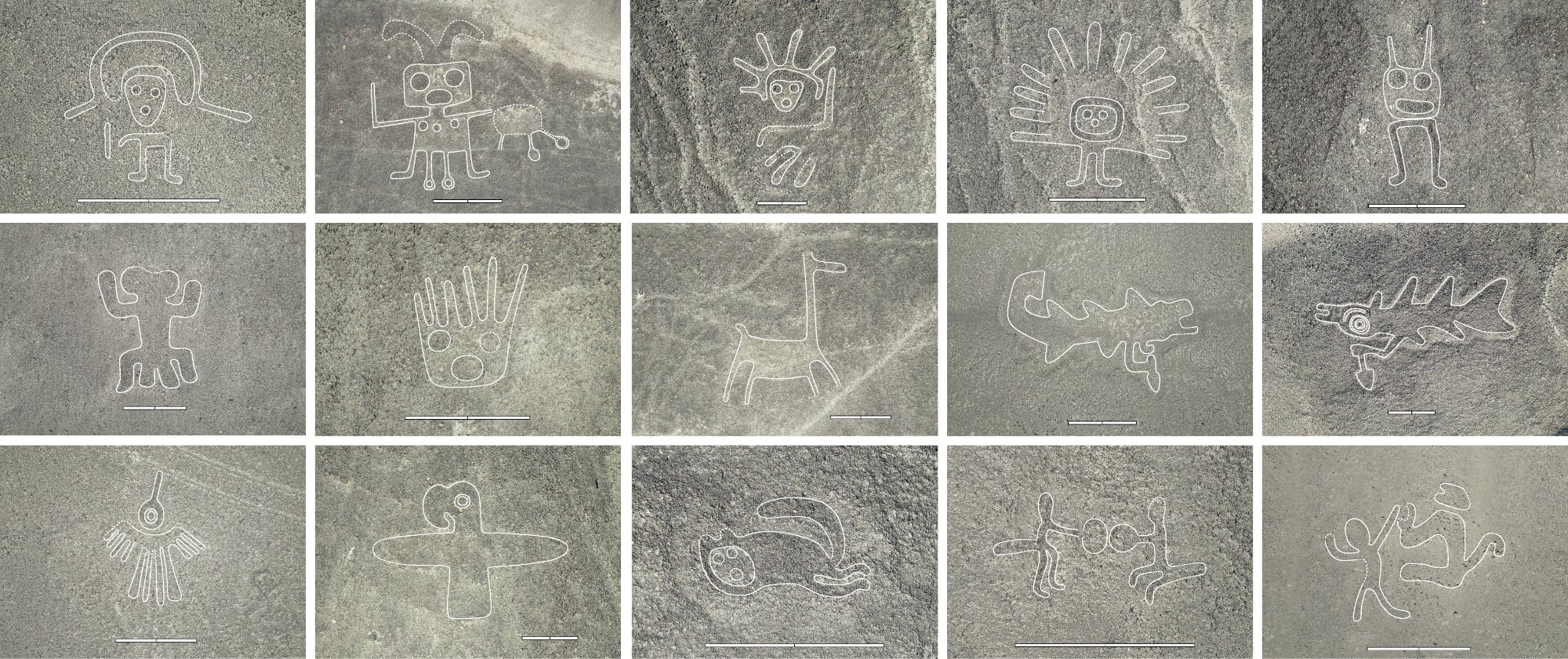
All images courtesy of Masato Sakai et al.

Thanks to a new A.I.-trained system, researchers have identified an additional 303 drawings in just six months.

In 2022, we shared news of a monumental discovery at Peru’s Nazca Pampa, a UNESCO World Heritage site once home to pre-Inca Indigenous peoples who were fond of etching gargantuan artworks into the earth’s surface. Discovered in 1927, archaeologists spent nearly a century uncovering 430 figurative glyphs depicting animals, people, and hybrid creatures.

But thanks to a new A.I.-trained system, researchers have identified an additional 303 drawings in just six months as detailed in a studypublished this week in the Proceedings of the National Academy of Sciences. Included in the findings are various birds, cats, ceremonial acts, and even a killer whale wielding a weapon.
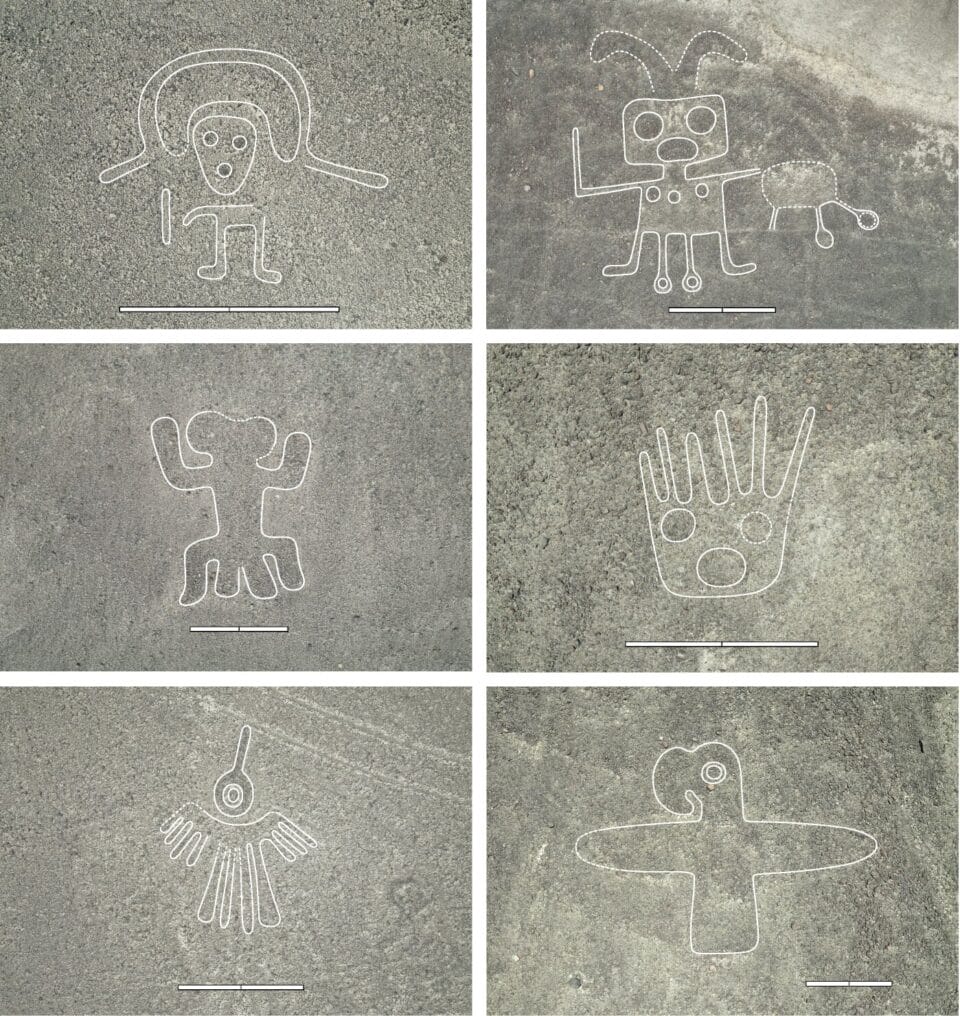
Dating back at least 2,000 years, the works offer insight into the cultural and spiritual practices of the ancient civilization. Although theories about the purpose of the lines range from calendars to agriculture and human migration, researchers know they were made by removing darker stones to reveal lighter, desert sand below.

Whereas drones have helped to identify the giant line drawings that stretch across the desert, the A.I. model has been adept at detecting the smaller, relief-type renderings that mainly portray wild animals and are more difficult to find.

The larger of the glyphs depict primarily humans, domesticated animals, and lone heads and “are typically located within viewing distance (on average 43 meters) of ancient trails that crisscross the Nazca Pampa and were most likely built and viewed at the individual or small-group level,” researchers say, noting that the smaller “are found an average of 34 meters from the elaborate linear/trapezoidal network of geoglyphs, which suggests that they were probably built and used on a community level for ritual activities.”

Using aerial and satellite images of the site along with LIDAR data, archeologists trained the A.I. model to identify the sometimes imperceptible lines. The team then reviewed and confirmed the results by traveling to the location. They estimate that the A.I. model is 21 times faster at perceiving the works than humans. (via Smithsonian Magazine)

More: An A.I. Model Helped Uncover 303 Previously Unseen Nazca Lines in Peru — Colossal

Posted in Art | Tagged , , , , | Leave a comment

How the Arabic language is like Giraffe species

Posted in Language | Tagged , , | Leave a comment