10 Apr 2026 #PlanetA #Austra #Trains
As Europe’s rail giants scrapped their sleeper cars, one tiny country went all‑in. Austria’s ÖBB has built the continent’s largest night train network, carrying millions across borders while everyone else hit the brakes. Here’s how Austria quietly conquered the night.
#PlanetA #Austra #Trains
Credits:
Reporter: Katharina Schantz
Camera: Henning Goll
Video Editor: Andreas Hyronimus
Supervising Editors: Kiyo Dörrer, Michael Trobridge, Malte Rohwer-Kahlmann
Fact Check: Kirsten Funck
Thumbnail: Em Chabridon
Chapters:
00:00 Intro
00:48 Room tour
05:40 Night train history
07:00 Dinner break
08:18 Austria’s advantages
11:50 The industry’s qualms
14:36 Private players
16:09 Conclusion
We’re destroying our environment at an alarming rate. But it doesn’t need to be this way. Planet A explores the shift towards an eco-friendly world — and challenges our ideas about what dealing with climate change means. We look at the big and the small: What we can do and how the system needs to change. We’ll take a truly global look at how to get us out of this mess.
8 Apr 2026 Asia Specific
Nasa’s Artemis II lunar mission shows a renewed US focus on the Moon, but it’s not the only major power seeking to send a crew there.
China has been steadily building its space capabilities and is aiming to land its own astronauts, or taikonauts, on the Moon by 2030.
More than 50 years after the Apollo missions, both the US and China are working towards a sustained human presence on the Moon and eventually Mars.
So is this a new space race and can the world’s two superpowers ever work together?
In this episode of Asia Specific, host Mariko Oi speaks with astrophysicist Dr Brad Tucker from the Australian National University and BBC journalist Kethaki Masilamani to break down the significance of Artemis II, how China compares to the US in space, and what this growing competition could mean for the future of exploration, technology, and security.
00:00 Introduction
01:30 Why is Artemis II so important?
02:30 Updates on the Artemis II mission
03:05 Interview: Artemis II astronaut on seeing the far side of the Moon
04:10 Missions to Mars
05:10 Was China a factor in Artemis II mission?
06:12 Where is China now in space technology?
07:05 How did China space program advance so quickly?
08:01 China’s space spending and cost strategy
09:14 China’s state-led model vs US private space companies
10:31 Why are the US and China racing back to the Moon?
11:43 US and China timelines of space missions
13:13 How satellites are used in warfare
14:20 Beyond the US and China – other space players
15:41 Could China overtake the US in space?
17:03 Can the US and China collaborate in space?
Watch more episodes of Asia Specific here 👉🏽 • Asia Specific
Instagram: @bbcworldservice
Email: asiaspecific@bbc.co.uk
Presenter: Mariko Oi
Producers: Derek Cai, Rachel Lee
Camera: Rosalehin Bin Rosli, Khairul Danish Bin Mohd Roslee, Aimran Supardi, Syaik Muhammad Sidik
Editor: Bill Birtles
—————-
This is the official BBC World Service YouTube channel.
If you like what we do, you can also find us here:
Instagram 👉🏽 / bbcworldservice
Twitter 👉🏽 / bbcworldservice
Facebook 👉🏽 / bbcworldservice
BBC World Service website 👉🏽 https://www.bbc.co.uk/worldserviceradio
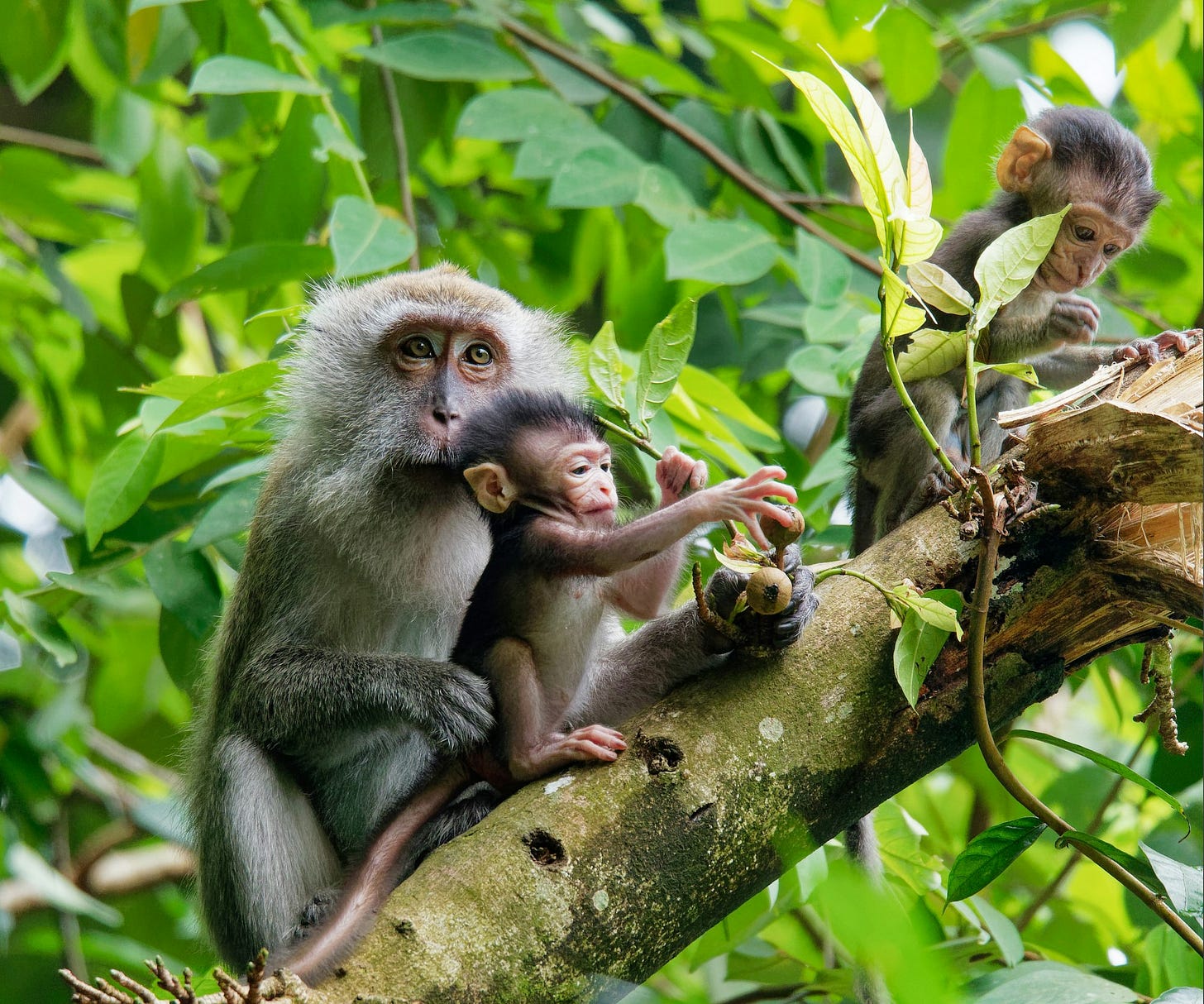
In scientific English, today we often distinguish between “monkeys” and “apes” in a meaningful way. Apes are the tail-less primates of the Old World that are close relatives of humans within the superfamily Hominoidea. Monkeys are (mostly) tail-bearing primates that are more distant relatives of ours. The monkeys are categorized into two different superfamilies: Ceboidea in the Americas and Cercopithecoidea in Africa, Asia, and Europe.
I’ve written before about how this distinction in English between “ape” and “monkey” can be confusing to anyone not deeply immersed in the taxonomy of primates. Humans are not phylogenetically separate from living great apes; the same common ancestors that connect those apes also are our ancestors. In other words, “apes” in English are not a proper monophyletic group, unless humans are also included. The same is true of “monkeys” – no way of grouping the ceboid and cercopithecoid monkeys is monophyletic unless the apes and humans are also included. (The branch that includes all of these primates is known as the Anthropoidea).
One of the most irritating aspects of talking with people about this is their lack of awareness of common terms in other languages. A certain chauvinistic type of scientist thinks that English words are the only ones that matter.
Just as most English speakers do not make the ape-monkey distinction the same way that taxonomists do, most other languages do not make an ape-monkey distinction in the way that English does.
This raises the question of exactly how English ended up with two distinct words for anthropoid primates, when England has no native non-human primates. It turns out that etymologists really don’t have a very good understanding of this.
A recent post on the Oxford English Dictionary blog looks into the history of the words “ape” and “monkey” in English: “Wrenching an etymology out of a monkey”.
The author, Anatoly Liberman, suggests that “monkey” has its origin in Dutch or Low German, and relates several stories that provide possible origins for the English word. But he also notes that these ideas do not satisfactorily explain superficially similar words in many other languages.
He offers the possibility that these words might have been borrowed from common sources as the primates themselves were traded as captive animals into different populations.
One might suggest that in French and Spanish we are dealing with the Germanic noun that lost its suffix, but this would hardly be a convincing solution. Also, Italian mona was recorded a hundred years before monkey surfaced in English, and a loan from German or Dutch is probably out of the question. I would risk the hypothesis that the Romance names of the monkey have nothing to do with their Germanic look-alikes. In Kanarese, a Dravidian language, the male monkey is called manga; a related Tamil noun sounds mandi. One may perhaps ask whether a migratory culture word for the monkey, known from India to northern Germany, enjoyed some popularity in the past. It may not be for nothing that so many similar simian forms have been found. If some such word traveled with the animal, in every country speakers would adapt it slightly under the influence of folk etymology. Whatever the answer, I believe that, as regards the etymology of Engl. monkey, both monks and the medieval animal epic should be left in peace.
The word “ape” comes down from Old English, and has cognate forms in German and other Germanic languages. In English until the twentieth century, “ape” could refer to any monkey or primate. […]
9 Apr 2026
AD – To try everything Brilliant has to offer for free for 30 days visit https://brilliant.org/DrBecky and you’ll also get 20% off an annual premium subscription which gives you unlimited daily access to Brilliant. | Nothing can travel faster than the speed of light. That is one of the most fundamental laws of all of physics. And yet… right now, the Universe appears to be expanding faster than that. Because space itself is expanding, when we look out at distant galaxies they appear to be moving away from us at faster than the speed of light, what’s known as “superluminal” motion. But Einstein famously showed that nothing can travel faster than light at 300,000km/s in his theory of relativity. It is a speed limit that applies across the entire Universe.
At first, this seems like a paradox with a fundamental law of physics somehow getting broken here, but rather counter-intuitively it’s not. Because the key to this isn’t about things moving through space…it’s about what space itself is doing. And even asking this question “of is the universe expanding faster than the speed of light” is a bit of a moot point, because the expansion technically doesn’t have a traditional “speed” either, it’s like asking am I heavier than I am tall? So in this video we’re going to dive into this cosmic loophole that allows the expansion of the Universe to appear to outrun light itself…
Every most distant galaxy known | Record Breakers – • Every “most distant galaxy known” from 192…
Why can’t anything go faster than the speed of light? – • Why can’t anything go faster than the spee…
If the Universe is expanding where is the centre? – • If the Universe is expanding, where is the…
00:00 Introduction
01:42 Why the galaxies themselves aren’t breaking the speed of light
05:15 Why the expansion of space doesn’t have a “speed limit”
10:43 Bloopers
🎧 Royal Astronomical Society Podcast that I co-host: podfollow.com/supermassive
—
🔔 Don’t forget to subscribe and click the little bell icon to be notified when I post a new video!
—
👩🏽💻 I’m Dr. Becky Smethurst, an astrophysicist at the University of Oxford (Christ Church). I love making videos about science with an unnatural level of enthusiasm. I like to focus on how we know things, not just what we know. And especially, the things we still don’t know. If you’ve ever wondered about something in space and couldn’t find an answer online – you can ask me! My day job is to do research into how supermassive black holes can affect the galaxies that they live in. In particular, I look at whether the energy output from the disk of material orbiting around a growing supermassive black hole can stop a galaxy from forming stars.

 msamba