New 3D cosmic map raises questions over future of universe, scientists say | Guardian

Nicola Davis Science correspondent
Thu 4 Apr 2024 16.00 BST

Researchers say findings from map with three times more galaxies than previous efforts could challenge standard idea of dark energy
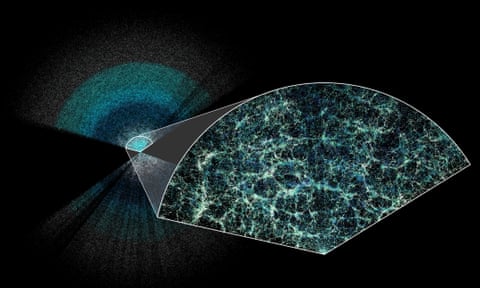
Image showing magnified section of part of the 3D map of the universe

DESI has made the largest 3D map of our universe to date. Earth is at the centre of this thin slice of the full map. In the magnified section, it is easy to see the underlying structure of matter in our Universe.
Illustration: Claire Lamman/DESI collaboration

The biggest ever 3D map of the universe, featuring more than 6m galaxies, has been revealed by scientists who said it raised questions about the nature of dark energy and the future of the universe.

The map is based on data collected by the Dark Energy Spectroscopic Instrument (Desi) in Arizona and contains three times as many galaxies as previous efforts, with many having their distances measured for the first time.

Researchers said that by using this map, they have been able measure how fast the universe has been expanding at different times in the past with unprecedented accuracy.

The results confirm that the expansion of the universe is speeding up, they added. However, the findings have also raised the tantalising possibility that dark energy – a mysterious, repulsive force that drives the process – is not constant throughout time as has previously been suggested.

Dr Seshadri Nadathur, a co-author of the work and senior research fellow at the University of Portsmouth’s Institute of Cosmology and Gravitation, said: “What we are seeing are some hints that it has actually been changing over time, which is quite exciting because it is not what the standard model of a cosmological constant dark energy would look like.”

Prof Carlos Frenk, from Durham University and a co-author of the research, said that if dark energy was indeed constant in time, the future of the universe was simple: it would expand on and on, for ever. But if the hints found in the map stood up, that would be called into question. […]

Continue reading: New 3D cosmic map raises questions over future of universe, scientists say

Posted in Astrophysics | Tagged , , , , | Leave a comment

How Beethoven made the Fifth Symphony

The first movement of Ludwig van Beethoven’s Fifth Symphony, performed by the Berlin Philharmonic, directed by Herbert von Karajan, with an animated graphical score.
FAQ

Q: What do the colors mean?
A: There are two versions of this video. In the original version …

• How Beethoven made the Fifth Symphony
… the colors are assigned to instruments:
flutes yellow-green
oboes green
clarinets blue-green
bassoons cyan
horns/trumpets yellow
timpani white
1st violins red
2nd violins pink
violas violet
violoncellos purple
contrabasses blue-purple
… and in the second version …

• Beethoven, Symphony 5, 1st movement (…
… the colors are assigned according to pitch (see https://www.musanim.com/HarmonicColor… for an explanation of how this works).

Q: I appreciate your videos; how can I support your work?
A: There are several ways:
free: like, subscribe, spread the word
donate: click the Thanks button
subscribe:

/ musanim
underwrite: https://www.musanim.com/underwriting

Q: Could you please do a video of _______?
A: Please see this:
http://www.musanim.com/requests/

[…]

Posted in Animation | Tagged , , , , , , | Leave a comment

The joy of abstract mathematical thinking – with Eugenia Cheng

Category theory is an abstract branch of mathematics – but did you know it can be both fun, and extremely useful for everyday life?

Watch the Q&A here:

• Q&A: The joy of abstract mathematical…
Buy Eugenia’s book here: https://geni.us/GBfELuE

Watch this clear and engaging talk on category theory, as Eugenia sheds light on how her speciality can be applied to many different areas of life, including inequalities, current events, and day to day living.

This talk was recorded at the Ri on 5 April 2023.

00:00 Introduction
06:54 What is category theory?
18:30 What is abstraction?
25:41 Why is context important in mathematics?
33:04 Relationships between things
41:21 Categories – history and definition
50:08 Conclusion

Subscribe for regular science videos: http://bit.ly/RiSubscRibe

Dr Eugenia Cheng is a mathematician, educator, author, public speaker, columnist, concert pianist and artist. She is Scientist In Residence at the School of the Art Institute of Chicago. She won tenure in Pure Mathematics at the University of Sheffield, UK and is now Honorary Visiting Fellow at City, University of London. She has previously taught at the Universities of Cambridge, Chicago and Nice and holds a PhD in pure mathematics from the University of Cambridge. Alongside her research in Category Theory and undergraduate teaching her aim is to rid the world of “math phobia”.

[…]

Posted in philosophy | Tagged , , | Leave a comment

Fantastic Flourishes…

Posted in Brazil | Tagged , , , , | Leave a comment

Red Bull sets a new world record by attempting to jump off a mountain into a moving plane

Posted in Design | Tagged , , | Leave a comment

Ulli Zerzer (@ullizerzer)| # contemporary sculpture

Posted in Art | Tagged , , , | Leave a comment

Polish mountaineer scaled his country’s highest peak…

Posted in Nature | Tagged , , | Leave a comment

Chris Hytha (@hytha.cg) | Art Deco > Glass boxes

Posted in Architecture | Tagged , , , | Leave a comment

Adaptation

Posted in Animal Behaviour | Tagged , , | Leave a comment

BBC World Service – Witness History, The Bluetooth story

Bluetooth was invented in the 1990s in Lund, Sweden

In the 1990s, Bluetooth was invented in a lab in Lund, Sweden.

The technology is used today to wirelessly connect accessories such as mice, keyboards, speakers and headphones to desktops, laptops and mobile phones.

It’s named after Harald Bluetooth, a Viking king who was said to have blue teeth.

Sven Mattisson, one of the brains behind the technology, tells Gill Kearsley how the name Bluetooth came about following some drinks after a conference.

(Photo: A mobile phone with the Bluetooth logo. Credit: Westend61 via Getty images)

Source: BBC World Service – Witness History, The Bluetooth story

Posted in Technology | Tagged , , , | Leave a comment