It’s All Henry VIII!: A Beginner’s Guide To The Dissolution of the Monasteries

Note: Have had a couple of comments to the effect that the interpretation of Leviticus 20:21 presented here is incorrect. To clarify: this isn’t my interpretation; it’s Henry VIII’s. You’re going to have to take it up with him, I’m afraid.

Order my book “Mavericks”: https://watkinspublishinglinks.com/ma…
ISBN: 9781786788986
Published by @Watkinspublishing1893 @watkinsbooks

Get tickets to the Chelsea History Festival here: https://chelseaheritagequarter.co.uk/…

Get in touch about London locations here: https://www.jdraper.co.uk/contact/

You can support the channel on Patreon here: http://www.patreon.com/jdraperlondon

You can book me for real-life tours! Find out about that here: http://www.jdraper.co.uk/private-tours

You can find me on the clock app here: http://www.tiktok.com/@jdraperlondon

Sources:
Ackroyd, P. 2012. The History of England, Vol. 2: The Tudors.
Bailey, M. 2014. The Decline of Serfdom in Late Medieval England.
Hornbeck II, J. P., Lahey, S. E., & Somerset, F., eds & trans. 2013. Wycliffite Spirituality.
McSheffrey, S. & Tanner, N., eds. & trans. 2003. Lollards of Coventry 1486-1522.

Music:

Tape Star
by Shane Ivers, http://www.silvermansound.com, CC-BY

Ave Maria II, S.38
by Franz Liszt
performed by Papalin, CC-BY

Toccata, Adagio and Fugue in C major
by Johann Sebastian Bach
performed by Paul De Bra, CC-BY

[…]

Posted in History | Tagged , , | Leave a comment

Why is there no B# or E# note on the piano?

Check out my video on why the white notes are C major and not A major: • Why are the white notes the C Major scale?

Why is there no black note between B and C or between E and F? Well, this is a simple sounding question with a not very simple answer. You’ll need to be sitting up in your seat for this one!

My video on Microtonality: • Does western music use Microtonality?
My video on 12-tone Equal Temperament: • Why pianos and guitars aren’t really in tu…

📌This video is a revised re-upload. I originally uploaded this video in April 2022, but soon realised from the reaction in the comments that I had skimmed over a lot of detail when it came to the major scale and the tones and semitones. This was causing confusion for many viewers so I’ve now decided to replace that video with this new, updated version. I’m much happier with the explaination in this video. Sorry again for any confusion caused by the original edition. You can still view the original version if you like here: • Why are there no black notes in these gaps…

And, an extra special thanks goes to Peter Keller, Douglas Lind, Vidad Flowers, Ivan Pang, Waylon Fairbanks, Jon Dye, Austin Russell, Christopher Ryan, Toot & Paul Peijzel, the channel’s Patreon saints! 😇

SUPPORT ME ON PATREON: / davidbennettpiano 🎹

SOURCES:
Early Music Sources – Musica Ficta: • Musica ficta!
Early Music Sources – Gregorian Chant: • Gregorian chant
Early Music Sources – Solmization: • Solmization and the Guidonian hand in the …
Early Music Sources – Modes: • Modes in the 16th and 17th centuries
Adam Neely & the tritone: • The Great Myth of the Medieval Tritone Ban
Adam Neely & the tritone (again!): • The Devil in music (an untold history of t…
The Hydraulis: • Justus Willberg plays the Hydraulis
12Tone – Why do notes have names?: • Why Do Notes Have Names?
The oldest playable organ in the world: • OLDEST PLAYABLE ORGAN IN THE WORLD Part 1 …
The Halberstadt organ:
https://second.wiki/wiki/orgel_des_do…
History of the organ: https://www.britannica.com/art/keyboa…
Cantus Firmus: http://www.estherlederberg.com/EImage…
Plainchant: https://www.britannica.com/art/mode-m…
Accidentals: https://www.britannica.com/art/accide…
History of Harmony: https://www.britannica.com/art/harmon…
The Hexachord: https://hasseproject.com/articles/hex…

0:00 Introduction
1:20 the Major scale
2:58 Microtonal notes
3:56 the history of music theory
12:23 Temperament
13:29 B# and E# exist in notation

[…]

Posted in Language | Tagged , , , , | Leave a comment

This photographer has spent over 9 years documenting solitary vending machines across Japan.

Posted in Photography | Tagged , , , | Leave a comment

Chengdu World Games opening ceremony fireworks

Posted in Technology | Tagged , , , , | Leave a comment

Fonts Hurt Culture

Posted in Technology | Tagged , , , | Leave a comment

After the atomic bombing of Hiroshima 80 years ago…

Posted in History | Tagged , , , | Leave a comment

What if you add up every drop of water on Earth?

Posted in Science | Tagged , , , | Leave a comment

London’s ‘Eighth Wonder Of The World’

Posted in History | Tagged , , , | Leave a comment

More than 70 Iconic Works by Kerry James Marshall Shape a Major Survey in the U.K. | Colossal

July 31, 2025
Art
Social Issues
Kate Mothes

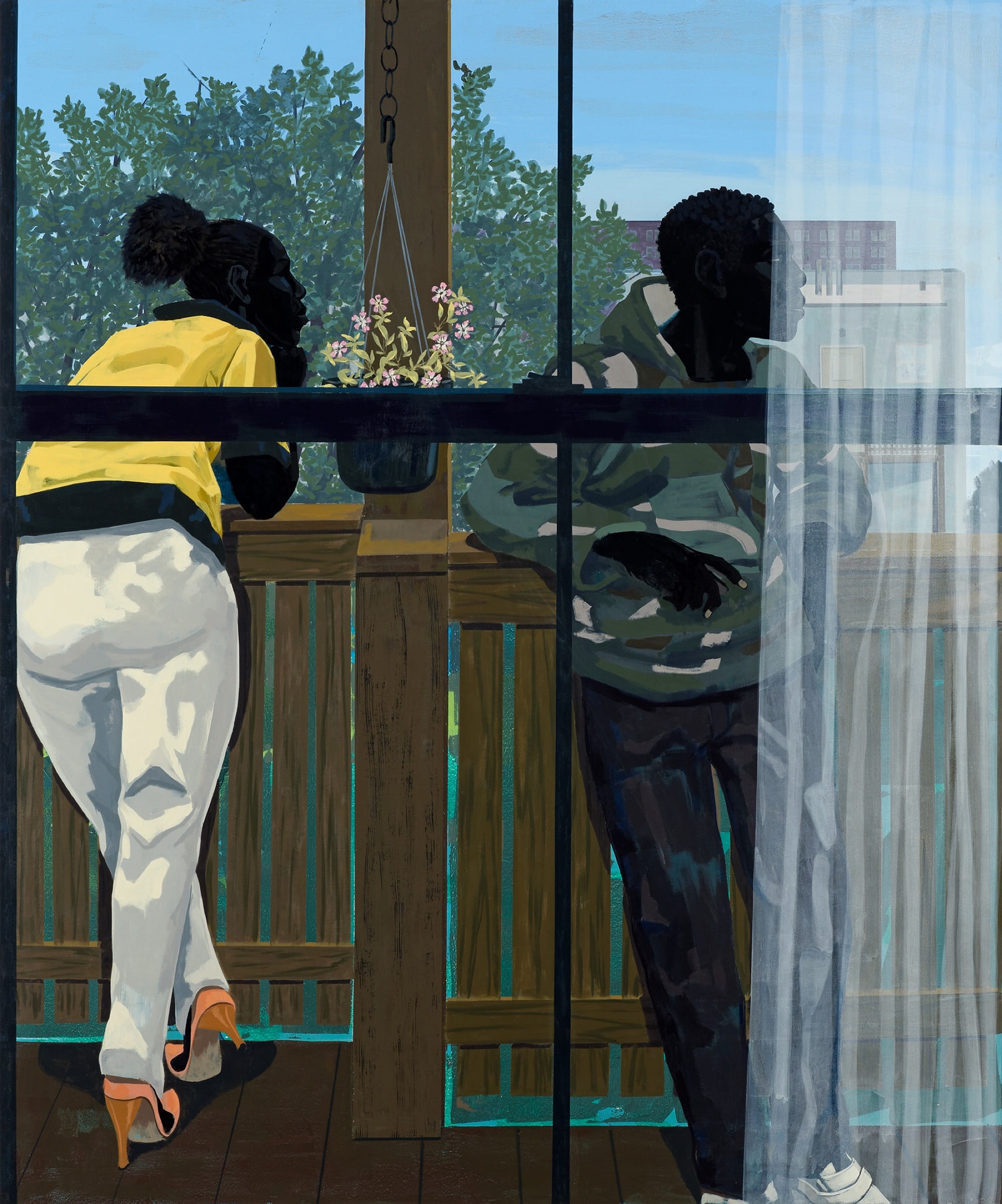
“Untitled” (2009), acrylic on PVC panel, 155.3 x 185.1 centimeters. Yale University Art Gallery, Purchased with the Janet and Simeon Braguin Fund and a gift from Jacqueline L. Bradley, B.A. 1979. © Kerry James Marshall. ‘Kerry James Marshall: The Histories’ is organized by the Royal Academy of Arts, London, in collaboration with the Kunsthaus Zürich and the Musée d’Art Moderne, Paris. All images courtesy of the Royal Academy of Arts

Drawing upon art historical sources, contemporary culture, and comics, Kerry James Marshall vibrant paintings boldly challenge the past. Through often monumental portraits of Black figures, the Chicago-based artist (previously) delves into themes of race, identity, legacy, and representation to bridge history and the present and imagine a better future.

In the largest survey of the artist’s work ever presented outside of the U.S., the Royal Academy of Arts hosts Kerry James Marshall: The Histories. Organized in collaboration with Kunsthaus Zurich and the Musée d’Art Moderne, Paris, the exhibition opens next month and features more than 70 works that span the artist’s career thus far. The show also includes a monumental oil painting commissioned for the Chicago Public Library titled “Knowledge and Wonder,” which is on loan for the first time.

“The Academy” (2012), acrylic on PVC, 182.9 x 154.9 centimeters. Collection of Dr. Daniel S. Berger, © Kerry James Marshall. Image courtesy of the artist and Jack Shainman Gallery, New York

The Histories is organized into 11 groups of works made between 1980 and the present, inviting viewers through a thematic and stylistic journey. The exhibition opens with “The Academy,” painted in 2012. A male model in a life drawing class stands in front of a patterned backdrop and looks directly at the viewer, giving the iconic raised fist of the Black Power movement.

Marshall has long been guided by his early encounters with European art in museums and books, where he recognized a stark lack of Black figures. By the 1980s, he focused on the idea of visibility, creating the seminal piece “A Portrait of the Artist as a Shadow of His Former Self,” which emphasizes his interest in confronting stereotypes. […]

“Vignette #13” (2008), acrylic on PVC panel, 182.9 x 152.4 centimeters. Susan Manilow Collection. © Kerry James Marshall. Image courtesy of the artist and Jack Shainman Gallery, New York

“Untitled (Porch Deck)” (2014), acrylic on PVC panel, 180.3 x 149.9 centimeters. Kravis Collection, © Kerry James Marshall. Image courtesy of the artist and David Zwirner, London

More: More than 70 Iconic Works by Kerry James Marshall Shape a Major Survey in the U.K.

Posted in Art | Tagged , , | Leave a comment

Game Theory of Power-to-the-Powerful

This video explains game theory of power-to-the-powerful. It looks at questions such as: What does it mean to “have power”? What is game theory? How do competition and cooperation coincide? What can we do about power-to-the-powerful?

Image credit for John Kenneth Galbriath:
By Hans van Dijk for Anefo – [1] Dutch National Archives, The Hague, Fotocollectie Algemeen Nederlands Persbureau (ANeFo), 1945-1989, Nummer toegang 2.24.01.05 Bestanddeelnummer 931-9937, CC BY-SA 3.0 nl, https://commons.wikimedia.org/w/index…

[…]

Posted in philosophy | Tagged , , , | Leave a comment