Right again, Einstein! Scientists find where matter ‘waterfalls’ into black holes | Space.com

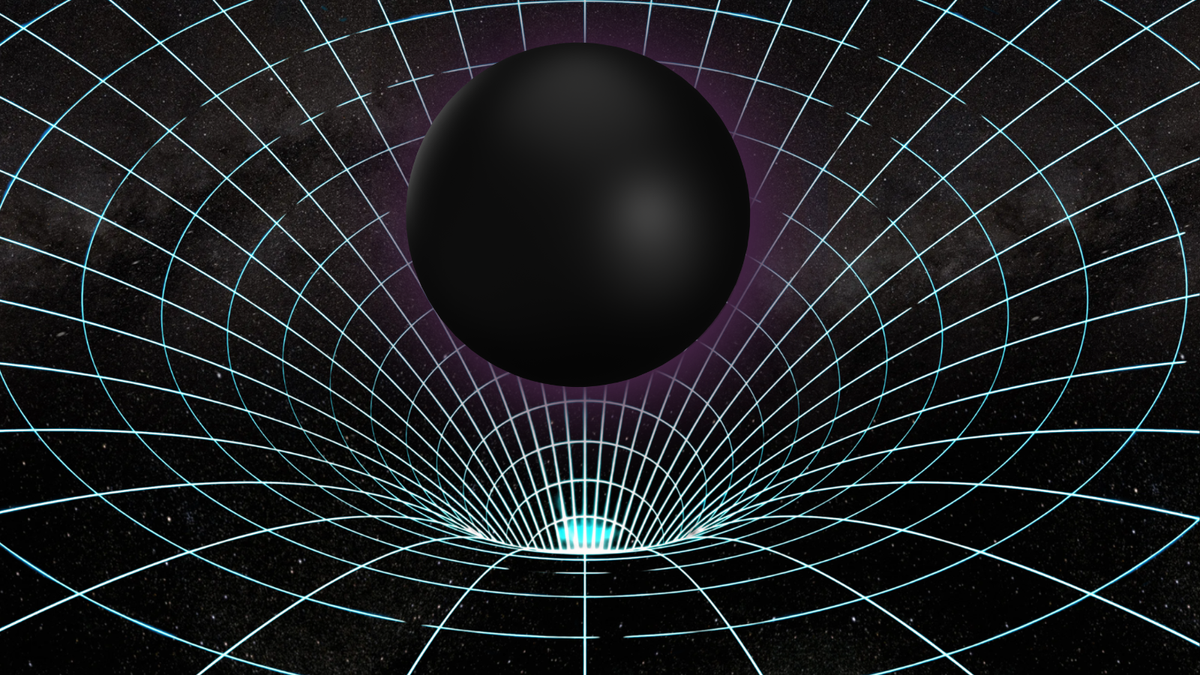
An illustration shows a black hole causing a “plunging” warp in spacetime. (Image credit: Robert Lea (created with Canva))

Scientists have confirmed, for the first time, that the very fabric of spacetime takes a “final plunge” at the edge of a black hole.

The observation of this plunging region around black holes was made by astrophysicists at Oxford University Physics, and helps validate a key prediction of Albert Einstein’s 1915 theory of gravity: general relativity.

The Oxford team made the discovery while focusing on regions surrounding stellar-mass black holes in binaries with companion stars located relatively close to Earth. The researchers utilized X-ray data collected from a range of space telescopes, including NASA’s Nuclear Spectroscopic Telescope Array (NuSTAR)and the International Space Station’s mounted Neutron Star Interior Composition Explorer (NICER). 

This data allowed them to determine the fate of hot ionized gas and plasma, stripped from a companion star, taking a final plunge at the very edge of its associated black hole. The findings demonstrated that these so-called plunging regions around a black hole are the locations of some of the strongest spots of gravitational influence ever seen in our Milky Way galaxy.

“This is the first look at how plasma, peeled from the outer edge of a star, undergoes its final fall into the center of a black hole, a process happening in a system around 10,000 light years away,” team leader and Oxford University Physics scientist Andrew Mummery said in a statement. “Einstein’s theory predicted that this final plunge would exist, but this is the first time we’ve been able to demonstrate it happening.

“Think of it like a river turning into a waterfall – hitherto, we have been looking at the river. This is our first sight of the waterfall.”
A “normal” star is in a binary system with a black hole with mass following from the former to the latter (Image credit: ICRAR)

Where does the black hole plunge come from?

Einstein’s theory of general relativity suggests that objects with mass cause the very fabric of space and time, united as a single four-dimensional entity called “spacetime,” to warp. Gravity arises from the resulting curvature.

Though general relativity operates in 4D, it can be vaguely illustrated through a rough 2D analogy. Imagine placing spheres of increasing masses onto a stretched rubber sheet. A golf ball would cause a tiny, almost imperceptible dent; a cricket ball would lead to a larger dent; and a bowling ball a massive dent. That’s analogous to moons, planets and stars “denting” 4D spacetime. As an object’s mass increases, so does the curvature they cause, and thus, their gravitational influence increases. A black hole would be like a cannonball on that analogous rubber sheet.

With masses equivalent to tens, or even hundreds, of suns compressed into a width around that of Earth, the curvature of spacetime and the gravitational influence of stellar-mass black holes can become quite extreme. Supermassive black holes, on the other hand, are a whole other story. They’re hugely massive, with masses equivalent to millions or even billions of suns, dwarfing even their stellar-mass counterparts.

Returning to general relativity, Einstein suggested this curvature of spacetime leads to other interesting physics. For instance, he said, there must be a point just outside the boundary of the black hole at which particles would be incapable of following a circular or stable orbit. Instead, matter that enters this region would plunge toward the black hole at near-light speeds. […]


Robert Lea is a science journalist in the U.K. whose articles have been published in Physics World, New Scientist, Astronomy Magazine, All About Space, Newsweek and ZME Science. He also writes about science communication for Elsevier and the European Journal of Physics. Rob holds a bachelor of science degree in physics and astronomy from the U.K.’s Open University. Follow him on Twitter @sciencef1rst.

More: Right again, Einstein! Scientists find where matter ‘waterfalls’ into black holes

Posted in Science | Tagged , , | Leave a comment

Rating strangers shots

Posted in Cities | Tagged , , | Leave a comment

Interesting fishing technique

Posted in Craft | Tagged , , | Leave a comment

Salvaged Scraps of Wood Nest Together in Richard Haining’s Elegant Curved Vessels | Colossal

MAY 20, 2024 GRACE EBERT

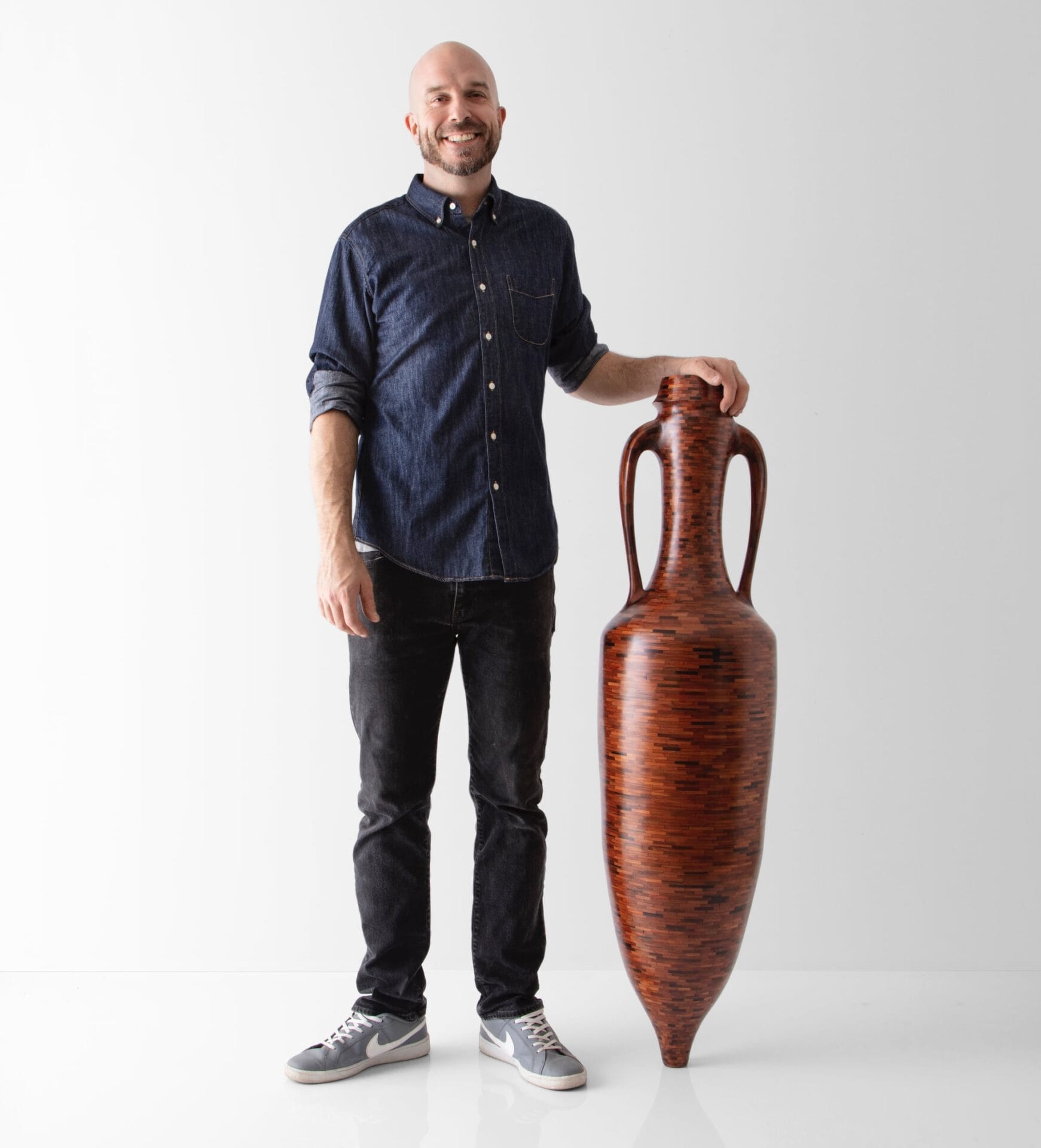
All photos by Joe Kramm, courtesy of Richard Haining

In the late aughts, Richard Haining began salvaging leftover wood. While working for a set design company, he realized that the sizable waste generated was also an untapped opportunity for his personal projects. “What I did not have in the way of disposable income, I did have in the way of access to tons of scrap materials,” he says. “I couldn’t afford purchasing new materials to create the ideas I had in my head, but I could take smaller scraps and use those as building blocks.”

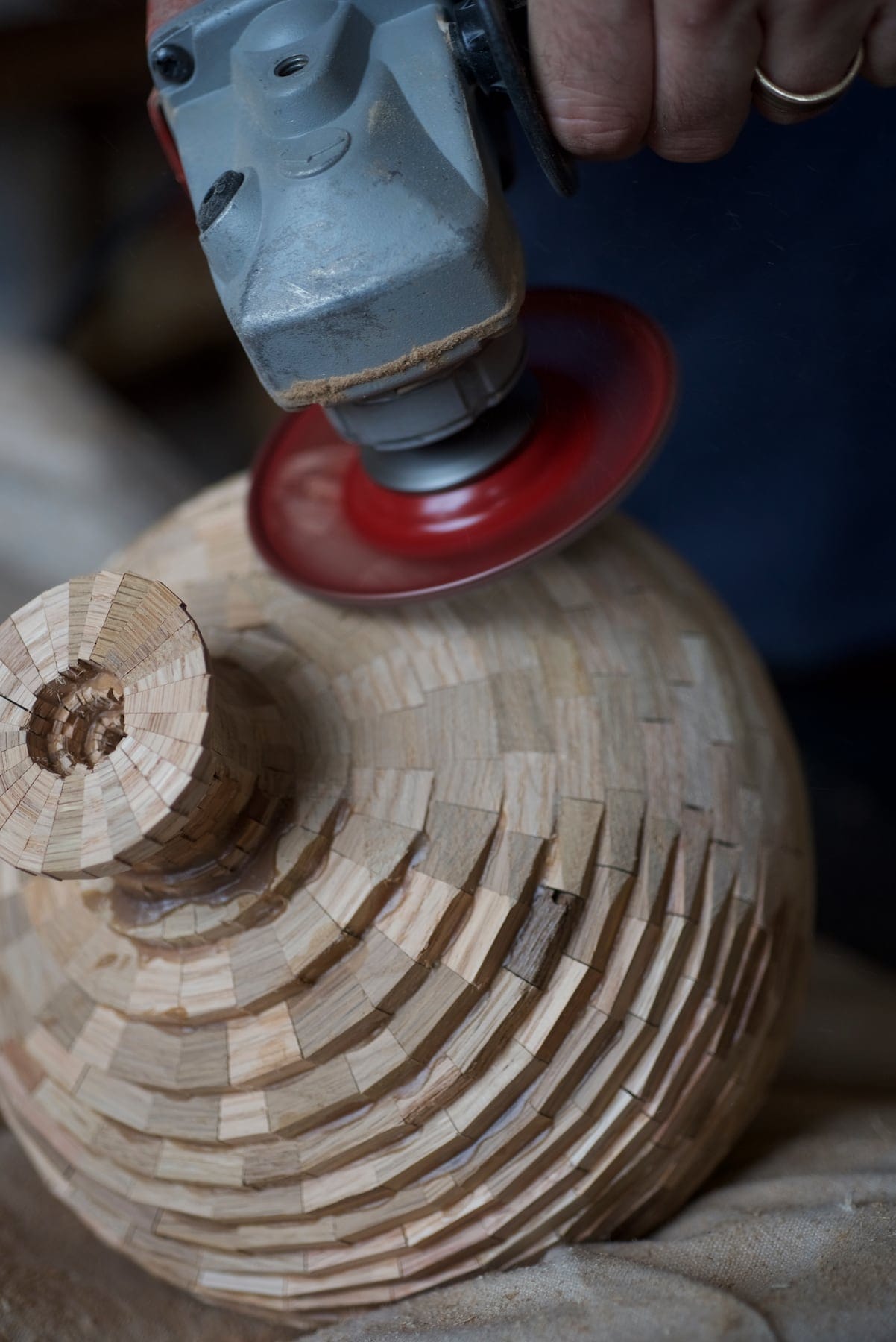
Armed with quarter-inch hunks of plywood pulled from the dumpster, Haining realized the first vessel in his ongoing STACKED series. The Brooklyn-based artist shapes each curvy form by gluing together each rung piece by piece, which lets him adjust the wall thickness and final profile as he works. “Imagine coil pottery…or an analog version of 3-D printing,” he adds, likening the process to ceramics. Once the shape is complete, he uses an angle grinder and various hand tools—but not a lathe—to smooth the surface and allow the individual grains to shine through. […]

More: Salvaged Scraps of Wood Nest Together in Richard Haining’s Elegant Curved Vessels — Colossal

Posted in Art | Tagged , , , , | Leave a comment

The Dorian Mode | Why Everyone Loves This Mode

In this episode I discuss in detail how to use the DORIAN MODE or Scale for composition (Film Scoring) or in improvisation on the Guitar, Piano or any instrument. I talk about the unique qualities of the DORIAN mode’s Natural 6th and WHY EVERYONE LOVES THIS SOUND.

[…]

Posted in Music | Tagged , , , | Leave a comment

Baths and Quarks: Solitons explained

17 Feb 2012
In ‘Baths and Quarks’, theoretical physics expert David Tong explains solitons and their effect on quarks and protons. ‘Solitons’ — solitary waves which can be seen as bubble rings in the bath — make it impossible for quarks and protons to be separated, thus holding together the universe, he says. “Baths would be so much more relaxing if they weren’t so interesting. Bubble rings – there’s something strange and unnatural about these objects – so structural where you wouldn’t expect to see structure. When I get out of the bath and pull the plug, there’s a world of water that drains away – a vortex – it’s very similar to the bubble rings, and objects like these may just hold the key to one of the most important problems in particle physics [relating to quarks and protons]. My name is David Tong. My job is to understand the beautiful things that I see in the world around me. But to describe them properly, I have to understand them in the language in which nature is written.”

[…]

Posted in Science | Tagged , , , | Leave a comment

Whale protects diver from shark

Posted in Animal Behaviour | Tagged , , | Leave a comment

When you run out of things to do with the cube

Posted in Art | Tagged , , | Leave a comment

A time lapse of various foods baking | Sixpenceee

Posted in Time Lapse | Tagged , , | Leave a comment

Toxic or Edible?? Amanita muscaria and other Mushroom Forager FAQ, Part 2 – S2E5

Part 1:

• You’re Doing It Wrong, No Matter What…

Toxic or Edible, Amanita muscaria. And other Mushroom Forager FAQ, Part 2

Want insight on some frequently asked questions concerning fungi and mushroom foraging? This video is part TWO of THREE in a SERIES of videos addressing mushroom misconceptions, common beginner inquiries and questions that YOU asked via Instagram stories (Thanks for all your submissions!). If you haven’t seen part ONE, be sure to check it out!

I took the opportunity to glean wisdom from all kinds of mushroom loving people when I recently attended the 2018 North America Mycological Association’s Annual Foray. I hope you enjoy hearing from myself, and all kinds of folks who are deeply invested in the world of fungi!

Also, subscribe, like, share and leave a comment of any other questions you may want addressed in the future!

The knife I use! – https://amzn.to/2RTEblc

The books!
Mushrooms of the Pacific Northwest – https://amzn.to/2RPKNRt
Mushrooms of the Redwood Coast – https://amzn.to/2B3NAB0
The Complete Mushroom Hunter – Gary Lincoff – https://amzn.to/2TbbWzW

Check out the list of links below! Some resources that follow along with topics covered in the video.

Amanita muscaria, toxic or edible? (Starts at 0:01)
For in depth information about the Amanita muscaria, this is a fantastic article. NOTE: This article states that no deaths have been attributed to A. muscaria, however since its publication a recently released study, “2006-2017 Summary of Mushroom Poisoning Reports in the NAMA Registry” by Michael W Beug, Chair NAMA Toxicology Committee, states a single death attributed to A muscaria (however indications there were likely other factors involved as well).
“A Study of Cultural Bias in Field Guide Determinations of Mushroom Edibility Using the Iconic Mushroom, Amanita muscaria, as an Example” by William Rubel and David Arora
http://davidarora.com/uploads/rubel_a…

Are too many people getting into foraging mushrooms and is it a concern that we are teaching more people to go out and pick mushrooms? (Starts at 6:30)

How can I get involved more with the science and research, do I have to get a degree to do so, how do I find a mentor to help? (Starts at 10:30)
If you aren’t part of a Mycological Society or Mushroom club, head to the North American Mycological Association’s Website and check out their index of clubs all around North America: Namyco.org
Note: Not all clubs are NAMA affiliates, there could be clubs local to you that are not on this list.

Great places to get started in some Citizen Science action (and yes, a full video on this topic has officially been filmed and is in the works!).
iNatrualist.org
MushroomObserver.org
Mycoflora.org

Are the spores of toxic mushrooms toxic for me to breathe? Will I get sick if I have a lot of mushrooms around me and I’m breathing in lots of spores? (Starts at 13:40)

Cryptoccocus gattii articles: (Note, it is the natural wafting of the fungal spores in the air that have affected people, it is not associated with a specific handling of mushrooms, which makes the disease impossible to avoid for both city dwellers or forest folk.)

NPR: https://www.npr.org/templates/story/s…

NY Times: https://archive.nytimes.com/www.nytim…

Subscribe!

If you want to catch up with my mushroom life more regularly, be sure to follow me on Instagram.

Yellow Elanor Instagram – http://www.instagram.com/yellowelanor
Zach Zoller Instagram – http://www.instagram.com/thezoller

YellowElanor.com
ZachZoller.com

[…]

Posted in Food | Tagged , , , , , | Leave a comment